

E-commerce platforms shape business operations. They determine how companies manage product catalogues, process orders, and serve customers. Adobe Commerce and Magento Open Source are the two big options today. Their foundations are similar. But licensing models and business capabilities set them apart.
Not every business needs enterprise features. An independent retailer may have simpler requirements than a manufacturer looking for customized Magento Open Source vs. Adobe Commerce. So, paying for unused capabilities increases costs. Choosing a basic platform for complex operations can create another challenge: expensive custom development.
Now you might think–which platform is right for your business? This Adobe Commerce vs Magento Open Source comparison details how they differ in features, development requirements, infrastructure and costs. By the end, it’ll help you find the one that fits your operational needs and future growth.
What Is Magento Open Source?
Magento Open Source is a free, open-source e-commerce platform that businesses can download, install and customize. Thinking–how it differs from Adobe. Magento open-source features allow businesses to adapt the software to their requirements.
Magento Open-Source Benefits:
- Administer catalogues by categorizing products, configuring attributes, and managing inventory.
- Customize payment methods, shipping options, and the checkout process.
- Process orders by reviewing your purchase history, issuing invoices, and updating order status.
- With Magento e-commerce development, managing customer accounts becomes simple.
- Configure coupon codes, catalogue price rules, and shopping cart discounts to promote your business consistently.
- Manage multiple websites and store views from one administration panel.
However, these Magento Enterprise features do not include hosting or managed infrastructure. The merchant must arrange server resources, security configuration, backups, upgrades and technical maintenance. Therefore, the absence of a license fee does not make the complete implementation cost-free.
What Is Adobe Commerce?
Adobe Commerce is the commercially licensed e-commerce product developed from the Magento Open Source codebase.
Adobe Commerce Benefits:
- Content staging by preparing and scheduling changes to product information, promotions, and store content.
- Adobe Commerce features let you group shoppers using defined characteristics and purchasing behavior.
- Access enhanced product discovery, recommendations and catalogue management services.
- Analyze commercial activity through additional reporting and analytics capabilities.
- Manage company accounts, shared catalogues, negotiated quotations and purchasing permissions through the relevant B2B offering.
Adobe Commerce platform also provides different deployment models. Businesses can select an on-premises installation, Adobe Commerce on Cloud Infrastructure (PaaS), or Adobe Commerce as a Cloud Service (SaaS). These options differ in infrastructure ownership, application control, and maintenance responsibilities.
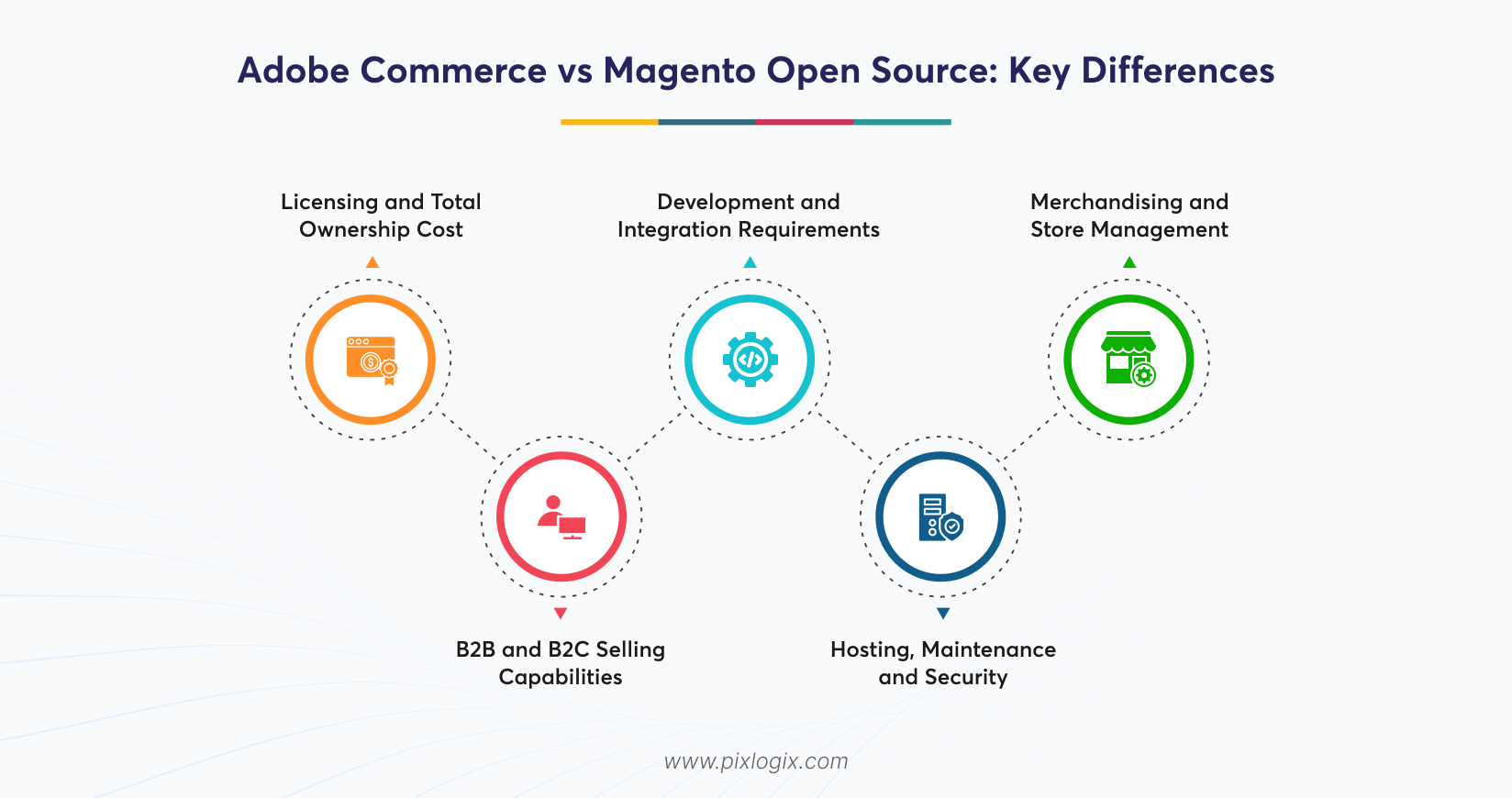
Adobe Commerce vs Magento Open Source: Key Differences
Both editions support essential online selling operations. Their differences become more important when an organization needs specialized purchasing workflows or additional management tools.
| Comparison Area | Magento Open-Source | Adobe Commerce |
| License | Free to download and under an open-source license. | Requires a paid commercial license. |
| Catalogue Management | Supports product creation, categories, attributes and inventory management. | Includes core catalogue tools with additional merchandising capabilities. |
| Content Management | Provides CMS pages, blocks, widgets and Page Builder. | Adds content staging and scheduling for managing store updates. |
| B2B Operations | Requires third-party extensions or custom development for company accounts and negotiated pricing. | Provides company accounts, purchase approvals, and negotiable quotes through its B2B offering. |
| Infrastructure | Requires businesses to arrange and maintain their own hosting environment. | Offers on-premises, Adobe-managed PaaS and SaaS deployment options. |
| Technical Support | Relies on community resources, internal developers and third-party providers. | Includes access to commercial Adobe support. |
| Reporting | Provides basic sales, order and product reports. | Offers additional reporting and analytics capabilities. |
| Customization | Allows source-code modifications, custom modules and third-party integrations. | Supports custom modules, integrations and enterprise-level development requirements. |
-
Licensing and Total Ownership Cost
Licensing is the key difference in our Magento vs Adobe Commerce comparison chart. There is no license fee for Magento Open Source. But hosting, development, extensions and maintenance add to Magento Open Source pricing. On the other hand, Adobe Commerce pricing requires a paid license.
So if you’re comparing both, consider implementation, infrastructure and ongoing expenses. Don’t just focus solely on the initial license price.
-
B2B and B2C Selling Capabilities
Magento e-commerce platform supports standard B2C transactions. This includes product browsing, checkout and payments. Magento B2B functionality requires custom development or third-party extensions.
Adobe Commerce B2B features include managing company accounts, buyer permissions, and negotiated quotes. This depends on the offering. These capabilities suit wholesalers, distributors and manufacturers handling multiple business buyers and approval workflows.
-
Development and Integration Requirements
Both editions support APIs and source-code customization. Developers can connect payment gateways, inventory applications, ERP systems and other business tools.
However, the implementation approach differs. Magento Open Source limitations may become apparent when a project requires extensive custom development for functions already available in the commercial edition. Adobe Commerce’s paid license includes a broader range of features designed for complex business operations. But developers must still configure integrations, test extensions and maintain application compatibility.
-
Hosting, Maintenance and Security
With Magento Open Source, merchants can choose their preferred hosting provider. They can also manage server configuration, backups, monitoring and application updates.
Adobe Commerce provides additional infrastructure choices. Its PaaS model offers Adobe-managed cloud infrastructure. Meanwhile, their SaaS option transfers more application and infrastructure management to Adobe.
Thus, neither licensing model removes the need for proper security practices. Access controls, vulnerability monitoring, and application configuration remain important considerations.
-
Merchandising and Store Management
Both platforms have unique benefits. They support content pages, product descriptions, promotions and catalogue administration. Magento Open Source also includes Page Builder for creating and editing store content. Thus, it should not be treated as an exclusive Adobe Commerce feature.
Additional enterprise tools are the key point of these e-commerce platform comparisons. These tools help larger teams coordinate catalogue changes and manage more targeted shopping experiences.
Adobe Commerce vs Magento Open Source: Which Is Right for Your Business?
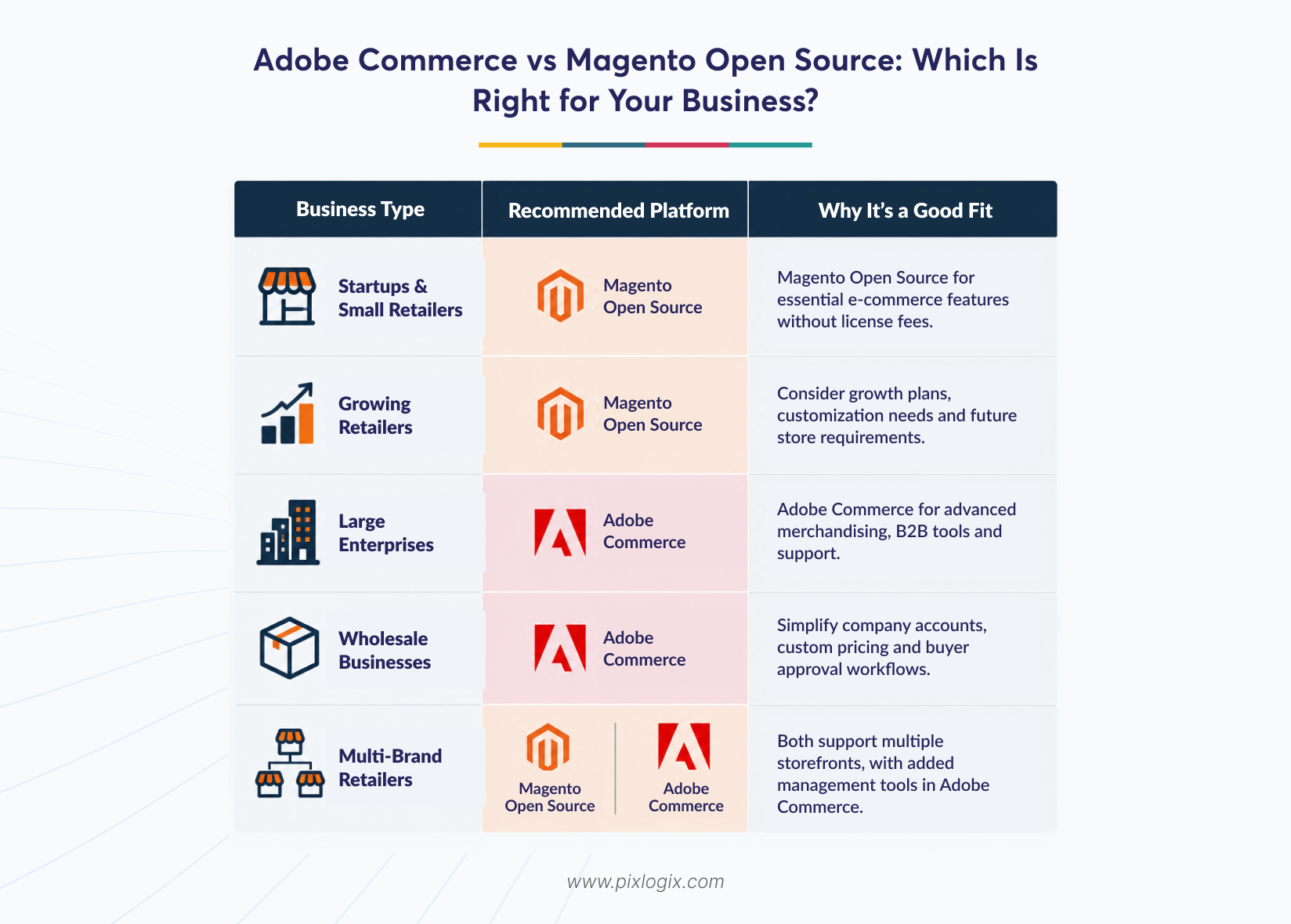
Adobe Commerce vs Magento Open-Source selection isn’t that easy. You must choose a platform that reflects actual selling requirements. Here’s how to pick:
Startups and Small Retailers
Magento Open Source for small businesses suits your simple store needing essential e-commerce features without license fees.
Growing Retailers
Assess Magento’s scalability and your development needs before investing in additional features or extensions.
Large Enterprises
Adobe Commerce for enterprise businesses offers advanced merchandising, B2B tools and commercial support.
Wholesale Businesses
Adobe Commerce simplifies company accounts, negotiated pricing and buyer approval workflows.
Multi-Brand Retailers
Both platforms support multiple storefronts, but Adobe Commerce offers additional management capabilities.
Cost Considerations
Compare Adobe Commerce vs Magento Open Source cost by including licensing, hosting, development and maintenance expenses.
Conclusion
In summing up, comparing both Magento Open Source vs Adobe Commerce both have their own benefits and challenges. Magento Open Source provides a capable foundation for retailers with manageable requirements and in-house development resources. On the other hand, Adobe Commerce is better suited to organizations that need dedicated B2B workflows, advanced merchandising or commercial infrastructure options. So, compare your present requirements with anticipated development and maintenance costs before committing to either platform.
Ready to build a future-ready Commerce platform? At Pixlogix, we help businesses evaluate their requirements, develop customized Magento solutions, and implement Adobe Commerce with the right features and integrations. Contact us today! Let’s discuss your project and find an e-commerce solution that supports your long-term business goals.

Frequently Asked Questions
Is Magento Open Source free to use?
Yes. Businesses can access, download and use Magento Open Source without paying a software licence fee. However, they must pay for hosting, development, extensions, security and ongoing maintenance.
How do Adobe Commerce and Magento Open Source differ?
Adobe Commerce includes additional enterprise features. They provide commercial support and deployment options. Meanwhile, Magento offers essential e-commerce functionality under an open-source license.
Can Magento Open Source support large e-commerce websites?
Yes. With suitable hosting, database optimization, and application configuration, Magento can handle enterprise-level e-commerce websites. It can support larger product catalogues, substantial traffic and complex store operations.
Does Adobe Commerce include advanced B2B functionality?
Yes. Its B2B offering includes company accounts, shared catalogues, negotiated quotes, buyer permissions and purchasing workflows. But it is based on the selected deployment and license.
Is Adobe Commerce worth the additional licensing cost?
It can be worthwhile when businesses need advanced B2B tools. Adobe’s high-level features can handle merchandising capabilities, commercial support and managed infrastructure. This justifies the additional investment.

Written by Samir Bhimbha Founder & CEO
Samir Bhimbha is the Founder & CEO of Pixlogix Infotech Pvt. Ltd. which offers web and app solutions to fulfill business's online needs and help to improve their online presence with many clients in the USA, Europe, Australia, and more. He is a skilled entrepreneur, web designer, developer, and team leader who can handle every situation. With 15+ years of experience in UX/UI design and web development, he is leading a team of IT professional talents.
Related Post


Why Businesses Need a Professional Web Development Company


Get in Touch Now!
Have a word with our expert consultants about your next project to get suggestive guidance & proposal.
Sales Inquiry


HR Inquiry
 India’s First SOTD Winner on Awwwards.com – 2010