

As an eCommerce business grows, its requirements grow with it. A larger product catalogue, more customers, additional sales channels, and complex operations can soon expose the limitations of a basic platform. That makes platform choice important.
Today, Magento e-commerce is the best option as it lets companies take greater control over their online operations. Its adaptable architecture and broad range of Magento features support stores with more complex requirements than a standard online setup.
In this blog, we’ll explore why Magento suits growing e-commerce businesses. We’ll also examine its capabilities, challenges, and suitability compared with other popular platforms.
What Is Magento and Why Is It Popular for eCommerce?
Magento is an open-source e-commerce platform. It is designed for businesses seeking extensive control over their online store platform. Adobe offers Magento too. Through Adobe Commerce, it provides an enterprise-focused commerce solution. But Magento Open Source remains available as a flexible foundation.
Its popularity comes from its ability to support complex operations. It lets businesses manage large catalogues, multiple storefronts, customer groups, integrations, and customized shopping experiences without forcing every business into the same structure.
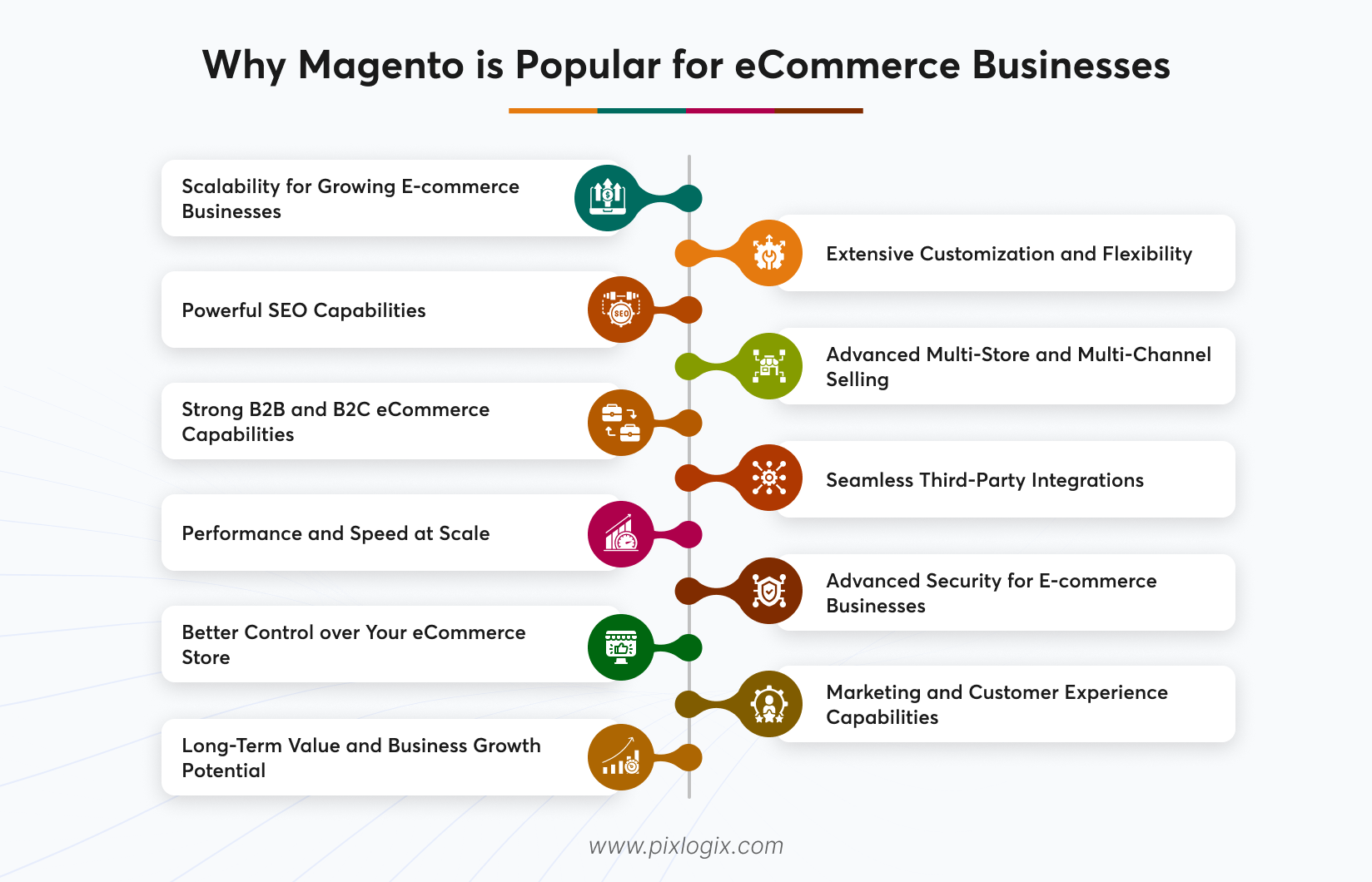
1. Scalability for Growing e-commerce Businesses
Magento supports growth without requiring a platform switch. As catalogues, customer traffic, and transaction volumes increase, it lets enterprises expand their online operations accordingly. This shows Magento is a scalable e-commerce platform. Its architecture provides room to introduce new products, sales models, and operational processes as business demands become more complex.
2. Extensive Customization and Flexibility
Every business has different needs. Magento allows developers to modify their storefront functionality, product structures, checkout processes, customer accounts, and workflows based on their unique requirements. That keeps businesses flexible. Thus, tailored Magento development services help companies create experiences around their products, customers, and internal processes.
3. Powerful SEO Capabilities
Magento has built-in security controls. Thus, it’s easy for developers to manage metadata, URL structures, canonical settings, redirects, XML sitemaps, and other elements. Precision matters for large catalogues. These controls make it easier to manage hundreds or thousands of product and category pages with greater accuracy.
4. Advanced Multi-Store and Multi-Channel Selling
Businesses often expand beyond one storefront. Magento supports them by letting them install multiple websites, stores, and store views with just one click. This keeps expansion organized. Different brands, regions, or product collections can be managed through separate storefronts.
5. Strong B2B and B2C eCommerce Capabilities
Magento can serve both these commerce needs. B2B stores can use it to create detailed product experiences and customer journeys. On the other hand, it helps B2B teams handle more operations. This includes their company accounts, custom pricing, purchase approvals, and negotiated terms. Thus, different models fit together. This makes Magento for businesses useful when companies serve multiple customer types or expand from one model into another.
6. Seamless Third-Party Integrations
Online stores rarely operate alone. Businesses may need integrations with payment providers, shipping systems, accounting software, CRM tools, ERP platforms, marketplaces, analytics systems, and other applications. That’s where you need connected systems. Magento’s integration capabilities help these tools work together, creating smoother workflows instead of managing each process separately.
7. Performance and Speed at Scale
Performance becomes more important as stores grow. Magento provides options for caching, indexing, database optimization, and content delivery that can support demanding storefronts when properly configured. However, speed is not automatic. Hosting, development practices, extensions, database management, and ongoing optimization all influence how quickly a Magento store performs.
8. Advanced Security for e-commerce Businesses
Security becomes more important as stores handle sensitive information. Magento offers several security controls. Access management, secure development practices, and regular platform updates can help protect online stores. Security needs ongoing attention. Businesses can strengthen protection through secure hosting, carefully selected Magento extensions, access restrictions, monitoring, and timely patch management.
9. Better Control over Your eCommerce Store
Magento gives businesses greater control over their stores. They can manage code, data, functionality, and configuration when standard settings cannot meet specific commercial requirements. That flexibility matters. Instead of changing business processes to fit the software, companies can use Magento website development to adapt the store around their operational needs.
10. Marketing and Customer Experience Capabilities
Magento supports targeted promotions. It includes product recommendations, customer segmentation, and personalized experiences. They better match different customer needs. Thus, marketing teams get more ways to refine their purchasing decisions.
11. Long-Term Value and Business Growth Potential
Magento can support long-term growth. Its flexibility can reduce the need to migrate when a business outgrows a basic online store platform. That makes it a practical foundation. With the right architecture and maintenance strategy, Magento development services can evolve with new products, markets, customer groups, and commercial models.
Challenges of Choosing Magento
Magento offers flexibility. But that flexibility can also bring greater technical responsibility and ongoing management needs. Look at the challenges they bring:
- Requires more technical expertise.
- Needs ongoing maintenance.
- Development and maintenance costs may be higher.
- Requires careful hosting.
- Needs proper planning.
Magento vs. Shopify vs. WooCommerce: Which Is Better for a Growing Business?
A business’s operating model plays a key role in choosing an e-commerce platform. It varies based on how much control the business needs over its store.
Shopify keeps the setup simpler. It suits businesses that prefer managed infrastructure, while WooCommerce works well for companies already using WordPress. Magento suits more complex operations. It can support complex workflows, multiple storefronts, and extensive integrations.
Is Magento the Right Choice for Your Growing eCommerce Business?
Magento suits growing businesses. It becomes especially useful when basic store functionality no longer provides enough control over commerce operations. Complex needs often require more. Large catalogues, multiple markets, or B2B and B2C requirements can make Magento a suitable choice. Their expert support can simplify implementation. An experienced Magento development company in India can help plan architecture, customize functionality, integrate external systems, and maintain the store as requirements evolve.
Conclusion
Magento suits growing businesses well. It can accommodate increasing complexity without placing strict limits on how an online store operates. Several features support this growth. This includes scalability, customization, multi-store support, integrations, SEO controls, and B2B capabilities. However, the right investment matters. Businesses prepared for capable development and ongoing management can use Magento as a strong foundation for sustained digital commerce growth.
Ready to build a scalable Magento store? Then, partner with a leading Magento development company in India like Pixlogix. We help you plan, develop, customize, and optimize a Magento solution around your business goals. Get a quote today! Let’s discuss your e-commerce requirements and guide you toward the next step.

Written by Samir Bhimbha Founder & CEO
Samir Bhimbha is the Founder & CEO of Pixlogix Infotech Pvt. Ltd. which offers web and app solutions to fulfill business's online needs and help to improve their online presence with many clients in the USA, Europe, Australia, and more. He is a skilled entrepreneur, web designer, developer, and team leader who can handle every situation. With 15+ years of experience in UX/UI design and web development, he is leading a team of IT professional talents.
Related Post
How to Safely Upgrade Your Magento 2 Store to the Newest Version

Magento Commerce Cloud: Top Benefits, Features, and Pricing

Get in Touch Now!
Have a word with our expert consultants about your next project to get suggestive guidance & proposal.
Sales Inquiry


HR Inquiry
 India’s First SOTD Winner on Awwwards.com – 2010