

Driving traffic to your e-commerce store is no longer the hard part. The real challenges lie in converting them. Did you know? The global e-commerce conversion rate is 2.5% to 3%. Dynamic Yield revealed this benchmark report in 2026. It highlights a massive opportunity for brands that invest in optimization.
A high-performing e-commerce conversion strategy goes beyond surface-level tweaks. It’s about engineering decision-making. It primarily focuses on strengthening trust signals.
Are you struggling to increase your e-commerce conversion rate? Then the chances are the issues lie within the experience itself. From unclear value propositions to complex checkout flows, every feature increases cart abandonment. This is where strategic optimization steps in. It focuses on behavioral insights and structured experimentation.
This blog breaks down how to approach the conversion of customers strategically. By the end, you’ll know how to unlock the full revenue potential of your existing traffic.
Understanding e-commerce Conversion Rate
At a surface level, the conversion rate optimization is a simple metric. It is the percentage of visitors who complete a desired action, typically a purchase. But in practice, it’s far more than a number. It’s a direct reflection of how effectively your website enables decision-making.
Modern e-commerce conversion optimization goes beyond tweaking headlines. It’s about analyzing the entire conversion funnel. In 2026, Baymard Institute revealed a shocking study. It stated that nearly 69.8% of online shopping carts are abandoned today. This is often due to avoidable friction.
Now, what to do to truly convert website traffic into sales? Or how to reduce cart abandonment? The answer is simple, every business must need a data-driven approach. They must conduct behavioral analytics or A/B testing to understand users. Then, continuously refine to reach better results that exceed user expectations.
Conversion Strategies for New Visitors (First-Time Buyers)
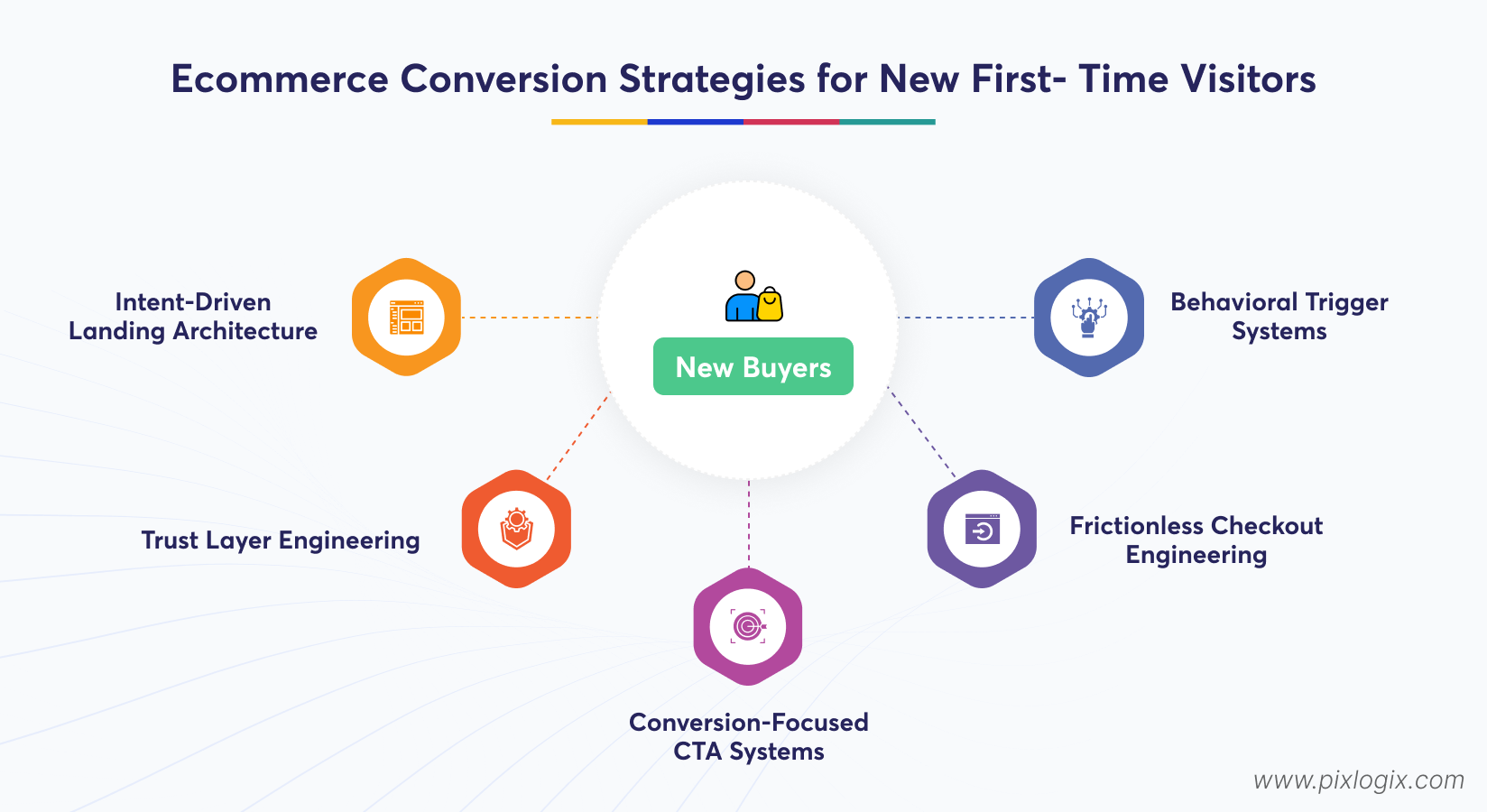
First-time visitors don’t convert due to a lack of interest. They drop off due to uncertainty. Want to know how to increase e-commerce conversion rate naturally? Follow these e-commerce conversion strategies:
1. Intent-Driven Landing Architecture (Not Just Pages)
Every website routes their traffic to static pages. But top brands build landing flows aligned with acquisition intent. For example, search, ads, or referrals. They also use GA4 funnel analysis with source-level segmentation. It helps them map drop-offs and refine entry points.
2. Trust Layer Engineering (Above-the-Fold Priority)
Integrate reviews, ratings, and return policies. Place them directly into high-attention zones.
3. Conversion-Focused CTA Systems (Tested, Not Assumed)
Replace passive CTAs with outcome-driven ones. Consider, you’re changing “Submit” to “Get My Free Quote”. Such CTAs consistently improve conversion intent alignment.
4. Frictionless Checkout Engineering
Checkout is where intent meets resistance. Enable guest checkout and optimize form fields using field-level analytics. Track abandonment through event-based funnels in GA4.
5. Behavioral Trigger Systems (Not Generic Pop-Ups)
Try to move beyond static pop-ups. And deploy event-triggered interventions (exit intent, scroll depth, inactivity). Also, personalize offers using behavioral signals instead of generic discounts.
The Takeaway: A strong e-commerce CRO strategy isn’t just about small tweaks. It’s about building a system that consistently drives conversions. The best brands focus on RPV (revenue per visitor). It ensures that every visit actually contributes to growth.
Conversion Strategies for Existing Customers (Repeat Buyers)
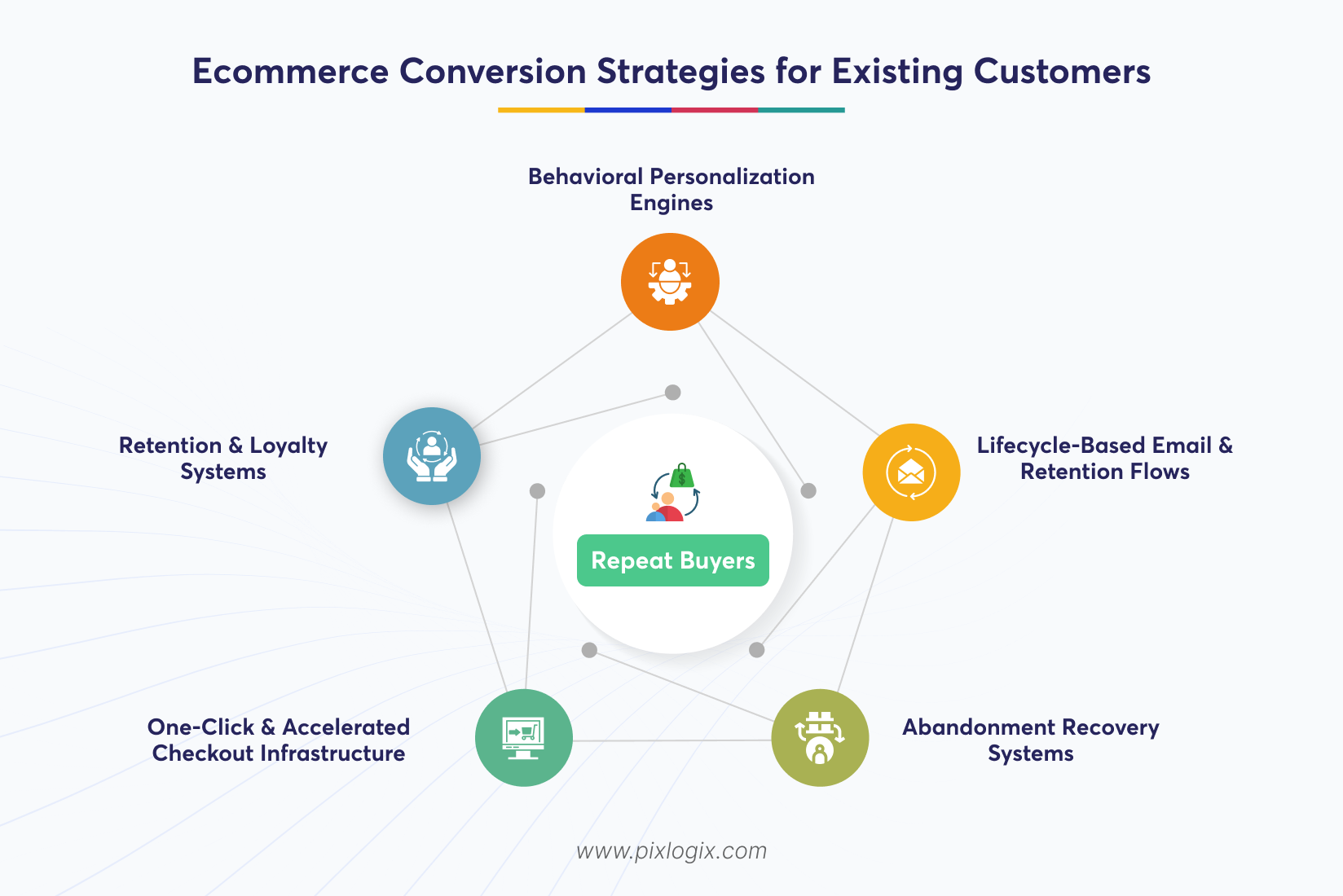
Repeat buyers don’t need convincing. They need speed, relevance, and continuity. This makes conversion optimization for an e-commerce website crucial.
1. Behavioral Personalization Engines
Move past “related products” and implement dynamic personalization. For customization, use tools like Segment. Leverage browsing history and purchase cycles. Check affinities to serve real-time content.
2. Lifecycle-Based Email & Retention Flows
Build automated flows based on the user stage. This includes post-purchase, inactivity, and loyalty milestones. Take help from tools like Klaviyo and HubSpot.
3. Abandonment Recovery Systems (Multi-Touch, Not One Email)
Treat cart abandonment as a recovery funnel. Use multi-step sequences like email, SMS, and push, which are triggered within hours. Optimize timing and messaging.
4. One-Click & Accelerated Checkout Infrastructure
Integrate tools like Google Pay and Apple Pay. These tools reduce checkout friction. Also, track checkout speed and completion rates as key performance indicators.
5. Retention & Loyalty Systems (Revenue Compounding Layer)
Introduce point-based rewards. If possible, add exclusive access. Make use of tools like Yotpo and LoyaltyLion. It helps operationalize retention strategies.
The Takeaway: Repeat conversions are driven by relevance and speed. For better results, team up with a trusted e-commerce web development company. They don’t just rely on leads. They focus on turning data into seamless buying experiences.
Key e-commerce Optimization Strategies (For Both Segments)
Conversion growth doesn’t come from isolated improvements. It comes from building a continuous optimization system. Keep in mind, a successful e-commerce website development agency operates on data loops. They work only with experimentation and predictive insights.
1. Full-Funnel CRO Framework
Track user journeys across the funnel. Get help from the top technical tools. They are GA4 and Mixpanel. Pinpoint the place where users don’t engage. Then, validate them through VWO and Optimizely.
2. Mobile-First Performance Optimization
Mobile performance is a crucial factor. So, include Core Web Vitals like LCP and INP. Also, focus on reducing load times. CDNs and lazy loading boost this process. A delay of just one second can significantly impact your conversions.
3. AI-Driven Personalization
Use artificial intelligence to predict user intent. It also helps you dynamically adjust content, offers, and product visibility. Top e-commerce websites often use trusted tools like Bloomreach or Adobe Sensei. Because it enables real-time decisioning.
4. Psychological Triggers Embedded in UX
Include social proof for building trust amongst users. Also, apply principles like scarcity, anchoring, and authority bias within UI components.
For example, show words like “Only 3 left in stock” or “20 people viewing this”. These insightful lines not only reduce hesitation. They accelerate decision-making.
5. Revenue-Centric Metrics Optimization (Not Just Conversion Rate)
Shift focus from the usual conversion rate. Instead of that, consider Revenue Per Visitor (RPV) and Average Order Value (AOV. These provide a more accurate picture of business impact.
The Takeaway: A strong e-commerce conversion rate optimization strategy is not static. It evolves with user behaviour. Technology and market dynamics also affect this.
Using Data & Analytics to Improve Conversions
Data doesn’t just optimize conversions. It prioritizes what to fix, when to act, and where revenue is leaking. The real advantage lies in transforming that raw data into decision intelligence. Because it helps visitors turn into customers predictably.
1. Prioritization Through Impact Analysis
Use impact vs effort models (ICE scoring). It helps you identify which changes will drive the highest revenue impact.
2. Micro-Conversion Tracking for Hidden Insights
Track all the smaller actions. For example, product views and add-to-cart rates. These signals reveal intent gaps before final conversion.
3. Cohort-Based Performance Analysis
Analyze user groups over time. This includes new vs returning and campaign-wise cohorts.
4. Predictive Analytics for Conversion Forecasting
Advanced teams often use AI models. They use it to forecast buying behaviour and identify high-intent users early. It proactively increases the eCommerce conversion rate.
5. Attribution Modelling for Smarter Investments
Move beyond last-click attribution. Use multi-touch models to understand which channels truly influence conversions.
The Takeaway: Data becomes powerful when it drives decisions. The brands that win use analytics to scale conversions strategically.
Common Mistakes That Hurt Conversions
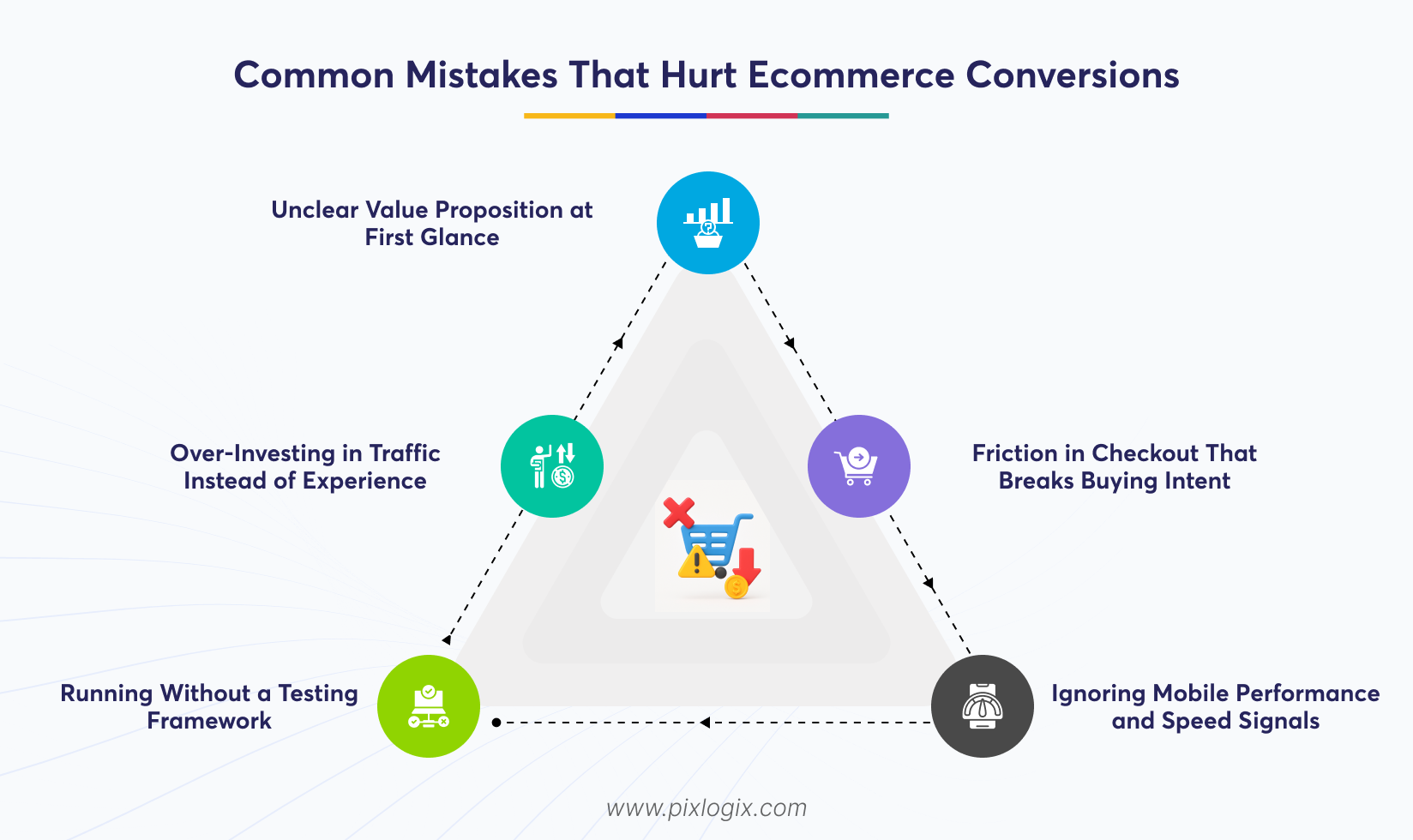
Most conversion drops aren’t random. The issue is a disconnect between user expectations and the on-site experience. E-commerce conversion rate optimization is all about identifying these issues. And focus on fixing those gaps at the source.
1. Over-Investing in Traffic Instead of Experience
Many brands scale paid campaigns before fixing on-site friction. This leads to high traffic but poor conversion efficiency. In GA4, this often shows up as strong session growth with stagnant conversion rates.
2. Unclear Value Proposition at First Glance
If users get confused, they leave. High bounce rates and low engagement time usually indicate messaging gaps. So, use heatmap tools like Hotjar and Clarity.
3. Friction in Checkout That Breaks Buying Intent
Long forms disrupt momentum at the most critical stage. Forced account creation and unexpected costs further elevate this issue.
4. Ignoring Mobile Performance and Speed Signals
Keep in mind, even small delays matter. Slow load times and poor Core Web Vitals create frustration. This leads to their silent drop-offs.
5. Running Without a Testing Framework
Assumptions are often a growth stall. This is the major reason why brands do A/B testing. They are using top tools like VWO or Optimizely.
The Takeaway: Conversions drop when friction goes unnoticed. The real impact comes from identifying these gaps early and fixing them with precision.
Conclusion
eCommerce growth is no longer a function of traffic volume. It’s a function of decision quality. The real differentiator lies in your e-commerce conversion strategy. Checking how effectively your website translates user intent into action across every touchpoint. Each interaction matters here. From first-time delivery to repeat purchases, all must be designed intentionally. Then, it must be continuously tested and precisely optimized.
Remember, high-performing brands don’t rely on assumptions or isolated improvements. Instead, they build a conversion infrastructure. It is powered by behavioral data, experimentation, and real-time personalization. This shift from tactics to systems is what every business needs. Because it increases e-commerce conversion rate.
Ready to turn your conversion strategy into a scalable growth engine? Then, partner with a leading e-commerce development company in India like Pixlogix. Our experts will help you build data-driven systems. By identifying conversion gaps, we optimize every stage of your funnel. Get a quote today! With high-grade e-commerce development services, we turn your website into a predictable revenue driver.

Frequently Asked Questions
What defines an effective eCommerce conversion strategy in 2026?
An effective strategy combines behavioural data, UX optimization, and continuous experimentation. It focuses on reducing friction, strengthening trust signals, and aligning user journeys to drive consistent purchase decisions.
Why do most eCommerce websites struggle with low conversion rates despite high traffic?
Low conversions often result from poor user experience, unclear value propositions, and checkout friction. Without aligning site experience with user intent, even high-quality traffic fails to convert effectively.
How can businesses reduce cart abandonment and improve checkout completion rates?
Streamline checkout by minimizing form fields, enabling guest access, and ensuring transparent pricing. Combine this with recovery flows like email and SMS to re-engage users and recover lost revenue.
Which metrics should businesses prioritize beyond conversion rate for growth?
Focus on revenue per visitor, average order value, and customer lifetime value. These metrics provide deeper insights into profitability and help optimize long-term growth beyond surface-level conversions.

Written by Samir Bhimbha Founder & CEO
Samir Bhimbha is the Founder & CEO of Pixlogix Infotech Pvt. Ltd. which offers web and app solutions to fulfill business's online needs and help to improve their online presence with many clients in the USA, Europe, Australia, and more. He is a skilled entrepreneur, web designer, developer, and team leader who can handle every situation. With 15+ years of experience in UX/UI design and web development, he is leading a team of IT professional talents.
Related Post

Top 10 Signs Your Website Needs Better UI/UX
Headless Commerce vs Traditional E-commerce
Why Your Website Generates Traffic but No Leads


Get in Touch Now!
Have a word with our expert consultants about your next project to get suggestive guidance & proposal.
Sales Inquiry


HR Inquiry
 India’s First SOTD Winner on Awwwards.com – 2010