

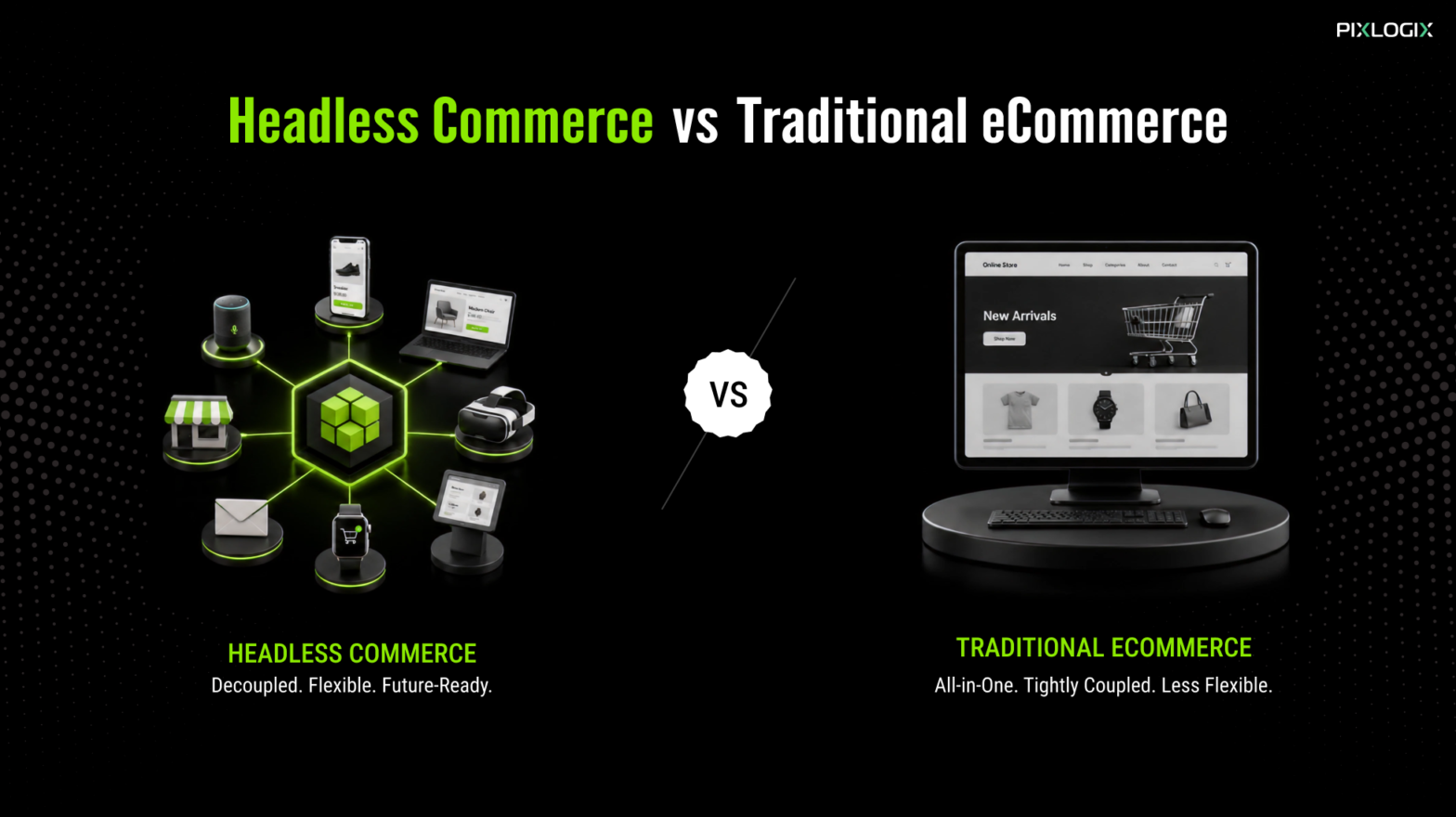
Traditional e‑commerce was built for simpler times. For them, it’s very difficult to support today’s omnichannel demands because of their tightly coupled architectures. They slow updates, limit flexibility, and complicate scaling. These challenges fueled the debate around headless commerce vs traditional e-commerce.
Thinking–Is headless commerce the right choice for every business? This blog breaks down the e-commerce architecture comparison. By the end, you’ll know how to find the right one that best aligns with your growth strategy.
What is Traditional eCommerce?
Traditional e‑commerce runs on monolithic architecture. The frontend, backend, and business logic operate as one tightly integrated application. They bundle everything together. The user interface, product catalogue, and checkout all share the same codebase. This forms one tightly integrated system. Platforms like Shopify, Adobe Commerce, and WooCommerce follow this model. Because they reduce technical complexity. This makes it a popular choice for businesses that need modern e-commerce solutions with ease.
How Traditional e-commerce Works?
Everything happens inside one app. In a traditional e‑commerce platform, every customer interaction is managed within a unified application. The frontend pulls data directly. It retrieves product information, pricing, inventory, and customer details straight from the backend, with changes made in the admin panel. It is also instantly reflected across the storefront. The presentation layer and backend remain tightly connected, with customization relying on themes, templates, and plugins. Thus, it’s simple to use.
Core capabilities of Traditional e-commerce
- Monolithic architecture with an integrated frontend and backend.
- Centralized management of workflows.
- Theme- and template-based storefront customization.
- Extensive plugin and extension ecosystem.
- Faster deployment with lower development complexity.
Limitations of Traditional e-commerce
- Less frontend flexibility
Storefront customization often requires backend modifications.
- Difficult omnichannel delivery
Supporting apps, marketplaces, and other channels requires additional integrations.
- Scaling challenges
Shared infrastructure can affect performance during traffic spikes and catalogue growth.
- Slower development cycles
Tightly coupled frontend and backend slow feature releases and UI updates.
- Platform dependency
Customization is restricted by platform architecture, templates, and supported technologies.
What is Headless Commerce?
Headless commerce is an API-first commerce architecture. It separates the presentation layer from the commerce engine. Also, it doesn’t rely on a single application to manage both the storefront and business operations. Instead, it allows each layer to evolve independently. This architecture gives businesses greater flexibility to build customized shopping experiences. It also helps build a centralized system for commerce operations.
How Does Headless Commerce Work?
Every customer interaction begins at an independent frontend. When users browse products or complete a purchase, this model sends API requests to the backend. It processes them and returns the required data. With API-based communication, businesses can redesign storefronts without starting from scratch.
Core Capabilities of Headless Commerce
- API-first architecture connects frontend with backend.
- Freedom to use modern frameworks. This includes React, Next.js, or Vue.
- Faster page loads through optimized, decoupled frontends.
- Easy integration with third-party tools. From CRMs and CMSs to marketing platforms, everything works seamlessly.
- Built for omnichannel delivery.
Headless Commerce vs Traditional Ecommerce (Comparison Table Section)
Every commerce architecture comes with trade-offs. Here’s a side-by-side e-commerce architecture comparison that highlights the essential factors.
| Factors | Traditional E-commerce | Headless E-commerce |
| Flexibility | Customization is constrained by platform themes, templates, and built-in capabilities. | Frontend and backend evolve independently. This enables complete design and technology flexibility. |
| Performance | Heavy themes, plugins, and server-side rendering can impact page speed as stores grow. | Decoupled frontends optimize content delivery. This improves page speed and Core Web Vitals. |
| Scalability | Expanding across multiple digital channels is quite difficult. It often requires additional integrations and custom development. | API-first architecture supports all workflows. From websites to mobile apps, all touchpoints work from a unified backend. |
| Development complexity | Easier to build and maintain with minimal development effort for standard storefronts. | Requires API expertise and frontend frameworks. The right architectural planning is also essential for successful implementation. |
| Cost | Setup costs stay low. Small and medium‑sized businesses rely on this way to launch quickly without complex infrastructure. | Initial setup cost is high. But leading enterprises often prefer this as it offers long-term scalability, flexibility, and ROI. |
You’ve seen both sides clearly. Now analyze their capabilities, from features to cost and choose the architecture that supports sustainable innovation.
Which One Should You Choose?
Every business has different priorities. So, understand your operational requirements and future roadmap to find the right commerce architecture.
Choose Traditional e-commerce if:
- You’re looking for a limited catalogue.
- Your team has minimal technical resources or in-house developers.
- You need to launch quickly without heavy customization.
- You have budget constraints. And it matters more than long-term flexibility.
Choose Headless Commerce if:
- You sell across multiple channels.
- Page speed and user experience directly impact your conversions.
- You expect rapid growth.
- You want an architecture that scales with you
- You want to handle API integrations and custom builds.
Many growing brands are now approaching custom e-commerce development services providers. They help build headless storefronts tailored to customers’ catalogue size, base, and marketing stack. This lets them avoid the rigid limitations of off-the-shelf platforms with full control over design and functionality.
Future of e-commerce Development
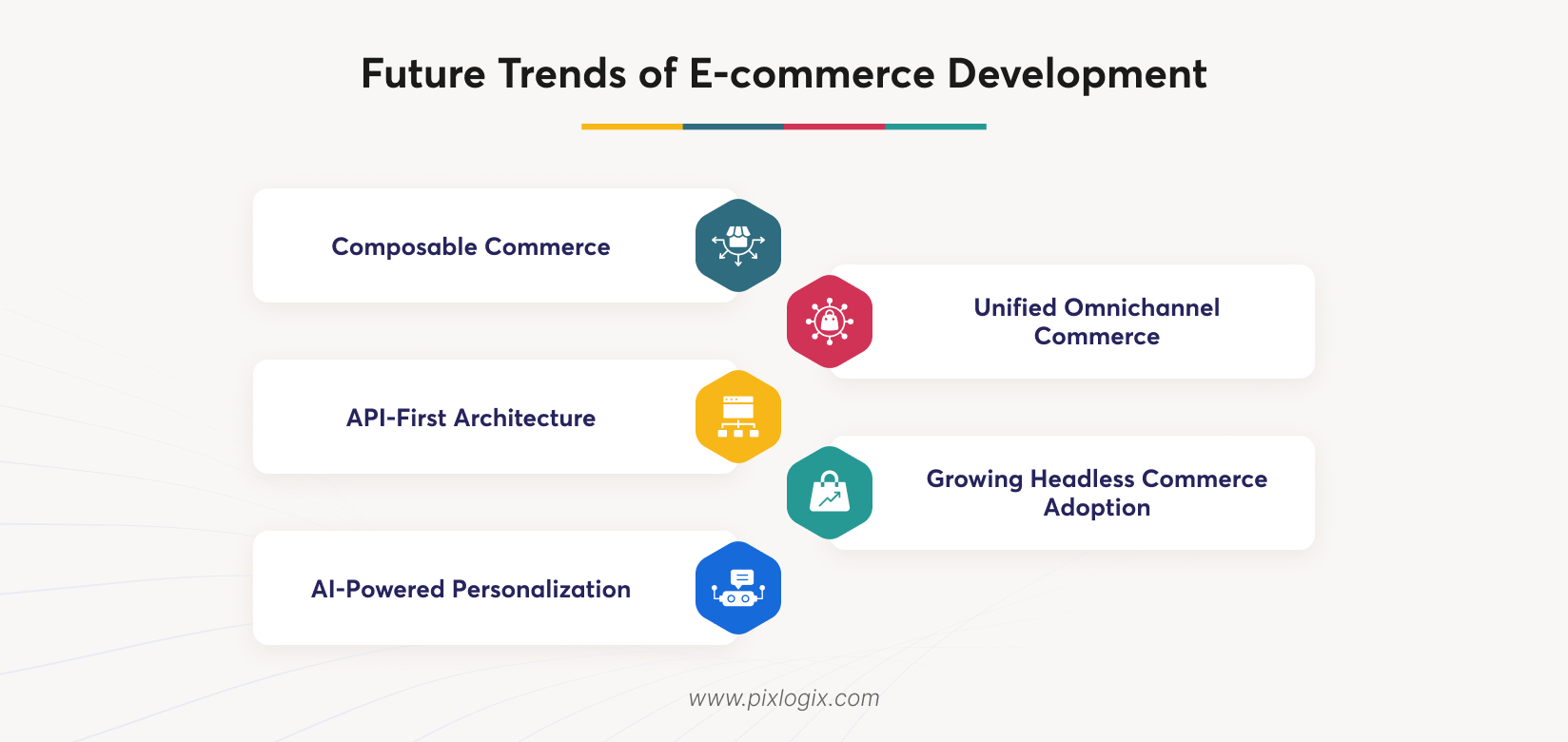
Commerce is evolving fast. Modern e‑commerce is shifting toward modular, API‑first architectures. Businesses are investing in flexible platforms. They want to stay future‑ready, positioning themselves to adapt quickly to changing technologies and rising customer expectations.
Here’s what the future unfolds:
- Composable Commerce
The best‑of‑breed is the new standard. Businesses are adopting specialized services to assemble flexible commerce ecosystems tailored to their unique needs and customer expectations.
- API-First Architecture
APIs unlock speed. API‑driven platforms simplify integrations and accelerate feature releases for agile innovation.
- AI-Powered Personalization
Insights fuel personalization. Intelligent recommendation engines and real‑time customer data deliver more relevant, tailored shopping experiences.
- Unified Omnichannel Commerce
Data stays in sync. Inventory, pricing, and customer records are synchronized to ensure consistent experiences.
- Growing Headless Commerce Adoption
Enterprises keep investing in headless. They aim to improve scalability, flexibility, and long‑term digital innovation.
Conclusion
Traditional and headless commerce solve different business challenges. Monolithic platforms simplify deployment. Meanwhile, headless architecture delivers the flexibility and scalability modern e-commerce solutions demand. So, start with clarity. Evaluate your technical requirements, growth plans, and customer experience goals to identify the right e‑commerce architecture. Ensure the choice you make supports long‑term success.
Is your platform ready for the next stage of growth? Then, partner with a leading e-commerce development company in India like Pixlogix. With top-grade e-commerce development services, we help businesses choose, build, and optimize the right architecture. Get a quote today! Let’s turn your vision into a scalable digital commerce solution.

Frequently Asked Questions
Is headless commerce worth the investment for a small or medium-sized business?
Yes, if your business needs faster performance, better customer experiences, or plans to grow across multiple sales channels. It offers long-term flexibility, though smaller businesses with simple needs may not require it immediately.
Can I migrate to headless commerce without changing my existing eCommerce platform?
Yes. Many businesses keep their current eCommerce platform and replace only the front end with a headless setup. This allows you to improve the customer experience without rebuilding your entire system.
What types of businesses benefit the most from headless commerce?
Businesses with high traffic, multiple digital channels, custom shopping experiences, or global operations benefit the most. It is especially useful for brands focused on growth, speed, and personalization.
Will switching to headless affect my existing integrations?
In most cases, your existing integrations can remain in place. However, some APIs or custom connections may need updates to ensure everything works smoothly in a headless environment.
When is a traditional eCommerce platform the smarter choice?
A traditional eCommerce platform is a better option for businesses that need a quick, budget-friendly solution with standard features and minimal customization. It is ideal for startups and smaller online stores with simple requirements.

Written by Samir Bhimbha Founder & CEO
Samir Bhimbha is the Founder & CEO of Pixlogix Infotech Pvt. Ltd. which offers web and app solutions to fulfill business's online needs and help to improve their online presence with many clients in the USA, Europe, Australia, and more. He is a skilled entrepreneur, web designer, developer, and team leader who can handle every situation. With 15+ years of experience in UX/UI design and web development, he is leading a team of IT professional talents.
Related Post
Top 10 Signs Your Website Needs Better UI/UX
Why Your Website Generates Traffic but No Leads

Get in Touch Now!
Have a word with our expert consultants about your next project to get suggestive guidance & proposal.
Sales Inquiry


HR Inquiry
 India’s First SOTD Winner on Awwwards.com – 2010