

Business websites have changed now. They’ve evolved far beyond static pages that simply list services, contact details, and a company profile. Website design in 2026 functions as a growth-driven system. It generates leads, improves conversions, and automates customer interactions.
Modern website features are a core asset. They support sales, marketing, and long-term growth. The 2026 Conductor’s AEO/GEO Benchmarks report shows them all. It states that nearly 61% of brands say AI-powered search is already reshaping how customers discover them online.
The digital future is here. Companies that want to stay competitive must go beyond surface-level business website features. They must embrace the latest standards and deeper functionality. In addition, they must leverage AI. Smarter systems deliver faster, more personalized experiences that feel natural to the user. All these business website essentials help convert consistently. Also, they adapt intelligently to changing customer expectations. So, today, businesses that succeed will be those that treat their websites as living systems.
Thinking–how to design a high-converting business website? Explore this blog! Here, we’ll break down the must-have web features that every company needs in 2026.
The Role of Modern Business Websites
Modern sites aren’t passive marketing tools. They are no longer simple placeholders for a company’s name, services, and contact details. In 2026, they function as active business tools. And they influence how customers discover a brand and interact with its team. A well-built website now supports far more than visibility. Every business website’s essentials support revenue, customer experience, and operational efficiency.
Intent starts here. For many businesses, the website is the very first place where curiosity turns into commitment. A visitor might learn about your site from anywhere. It might be through search, social media, or even a referral. But the website is where that interest is either captured or lost. That is why business website features are designed to do more than inform. They guide users, answer questions, and move prospects toward a clear next step.
From Digital Brochure to Growth Engine
The purpose of a website has fundamentally changed. Instead of just displaying company information, websites now function as lead generation systems. They focus on converting prospects. Every page is expected to support a specific business objective. Whether capturing leads, generating inquiries, scheduling consultations, or driving purchases, the latest website development trends meet them all.
Modern websites also integrate seamlessly with:
- Marketing automation platforms
- Customer Relationship Management (CRM) systems
- Customer support tools
- Analytics platforms
- Email marketing software
This interconnected ecosystem transforms websites into powerful revenue-generating assets. They convert them from static online destinations. For businesses planning website design 2026 strategies, this shift is essential to understand.
Why Outdated Websites Fail Today?
Websites built for an earlier digital era often fail because they no longer match user buying decisions. What once looked acceptable now creates friction. It weakens confidence and makes the business appear behind the market.
The problem is not just appearance. Older sites usually lack the structure, flexibility, and intelligence needed. They do not support modern trends like AI.
Poor UX
Visitors expect clear navigation and readable layouts. So, when a website feels confusing, cluttered, or difficult to use, people leave. They move before they fully understand the brand or its offer.
Slow loading speed
Even a short delay can reduce engagement. It increases bounce rates and creates frustration. Once users visit a slow-loading site, they exit and reach the fast competitor’s website.
Lack of mobile-first design
Most users browse on mobile devices. So, they do not visit a website that does not adapt properly. If buttons, text, or forms are hard to use on smaller screens, visitors quickly move on.
No conversion strategy or tracking
An outdated website often has no clear path. Without strong calls to action, funnel structure, or tracking, businesses cannot measure performance. They couldn’t improve results over time.
In short, outdated features reduce credibility. When the digital experience falls behind customer expectations, competitors with sharper systems naturally win the attention.
Must-Have Features for Business Websites in 2026
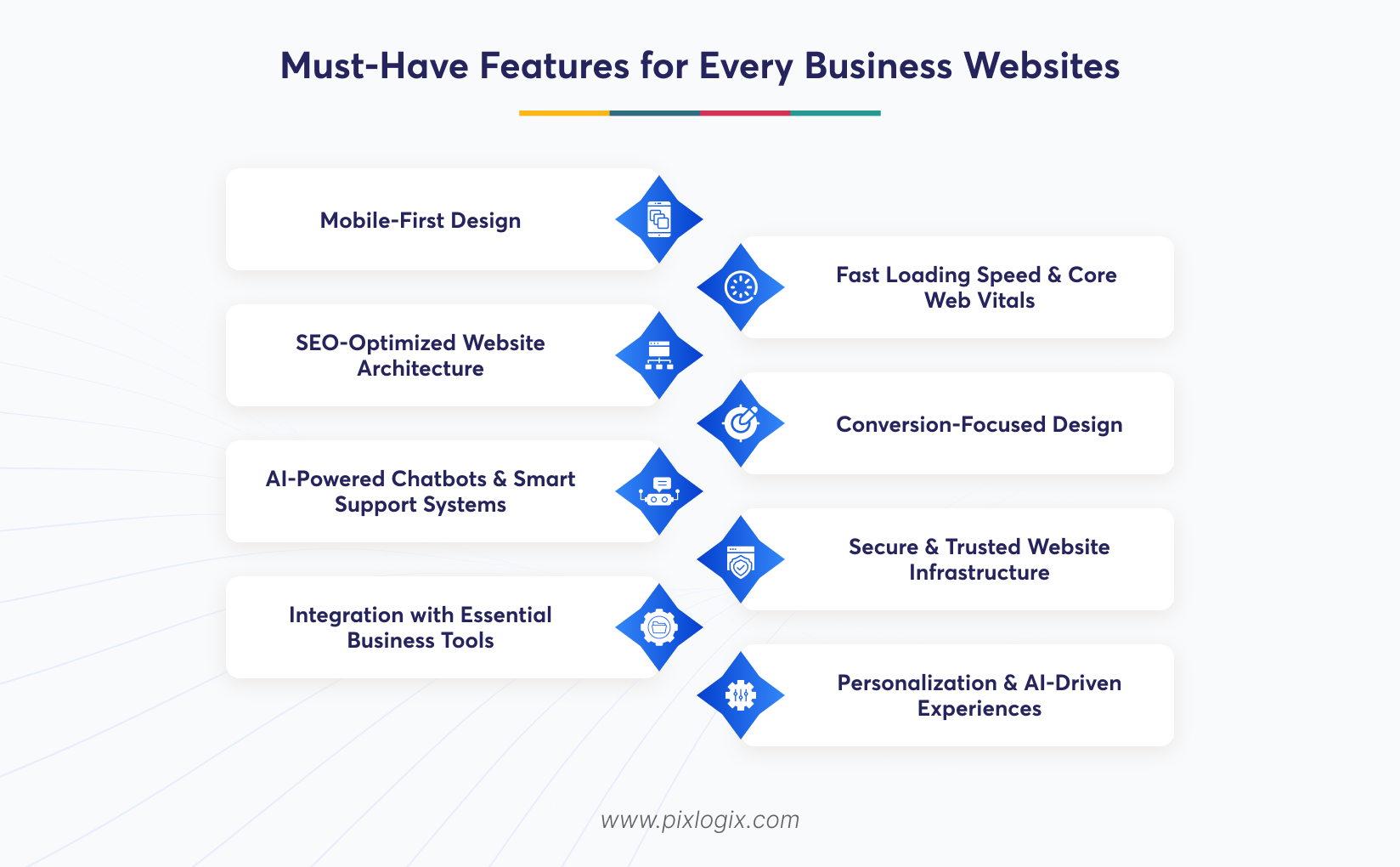
In 2026, websites have taken on a new identity. They operate as living digital ecosystems-built to convert and designed to engage. Also, they are engineered to adapt in real time.
Mobile-First Design
Mobile traffic is quite dominant these days. That’s where every business website needs responsive layouts that ensure seamless experiences across devices.
Their benefits include:
- Better user engagement
- Higher conversion rates
- Improved search rankings
- Reduced bounce rates
Businesses prioritizing website design 2026 strategies often win. They know that poor mobile performance means losing potential customers.
Fast Loading Speed & Core Web Vitals
Speed is critical. Websites that fail to meet Core Web Vitals benchmarks risk losing trust. That’s why optimized performance is one of the business website essentials.
A fast website delivers:
- Better user experience
- Higher search engine visibility
- Improved customer retention
- Increased conversion rates
Performance optimization should include:
- Image compression
- Code optimization
- Content delivery networks (CDNs)
- Efficient caching mechanisms
Fast-loading sites consistently outperform. They race slower competitors in both rankings and lead generation.
SEO-Optimized Website Architecture
SEO is non‑negotiable. It must be woven into the very foundation of a site. When optimization is built in from the start, businesses secure a future‑proof presence in search.
Modern website features should include:
- Clean URL structures
- Logical site hierarchy
- Internal linking strategy
- Schema markup implementation
- Search-friendly navigation
Today’s search engines use AI. It helps them understand content, which makes structured data even more important. Trends are shifting fast. Many leading website development practices now emphasize Answer Engine Optimization (AEO) and Generative Engine Optimization (GEO). They ensure every site stays relevant. That means they are highly visible in AI-powered search environments.
Conversion-Focused Design
Traffic alone does not generate business growth. A website must guide users toward meaningful actions through strategic design.
Key elements include:
- Clear calls-to-action (CTAs)
- Optimized landing pages
- Simplified navigation
- Trust-building design elements
- User journey mapping
Are you looking to develop a website that converts? Then, your focus must be completely on creating intuitive experiences. It must encourage users to take action. Every design choice should support a conversion goal.
AI-Powered Chatbots & Smart Support Systems
Wondering–what are the most impactful AI features in business websites? They are intelligent chatbots and automated support systems.
These modern tools can:
- Answer customer questions instantly
- Qualify leads automatically
- Schedule appointments
- Provide product recommendations
- Offer 24/7 support
These capabilities improve customer satisfaction. They also reduce the operational workload. AI is everywhere. They keep businesses responsive even outside working hours. And most importantly, they ensure no lead goes unanswered.
Secure & Trusted Website Infrastructure
Security is no longer optional. Customers expect their websites to protect their personal information. They want it to maintain high standards of privacy.
That includes:
- HTTPS implementation
- SSL certificates
- Secure hosting environments
- Regular software updates
- Data protection compliance
Trust and credibility directly influence conversion rates. This makes security a vital part of business website features. It reassures visitors that the brand is safe to engage with.
Integration with Essential Business Tools
Modern websites must work seamlessly with other business systems.
Critical integrations include:
- CRM platforms
- Email marketing tools
- Analytics solutions
- Customer support software
- Sales automation platforms
These integrations are helpful for automating workflows. More than that, it improves customer management. They also help them gain deeper insights into performance. For any web development company in India or elsewhere, integration capability is now one of the most important deliverables in website projects.
Personalization & AI-Driven Experiences
Customization counts. It’s one of the most critical factors when designing a website because no two businesses share the same needs or audience. Artificial intelligence takes this further. It learns from behavior and delivers smarter experiences.
This action happens based on:
- Browsing history
- User interests
- Geographic location
- Previous interactions
Examples include:
- Personalized content recommendations
- Dynamic service suggestions
- Customized landing pages
- Behavioral targeting
These AI features on business websites significantly improve engagement. They increase retention and conversion rates. When users feel that a website understands their needs, they trust the brand and take action.
Future-Ready Website Capabilities
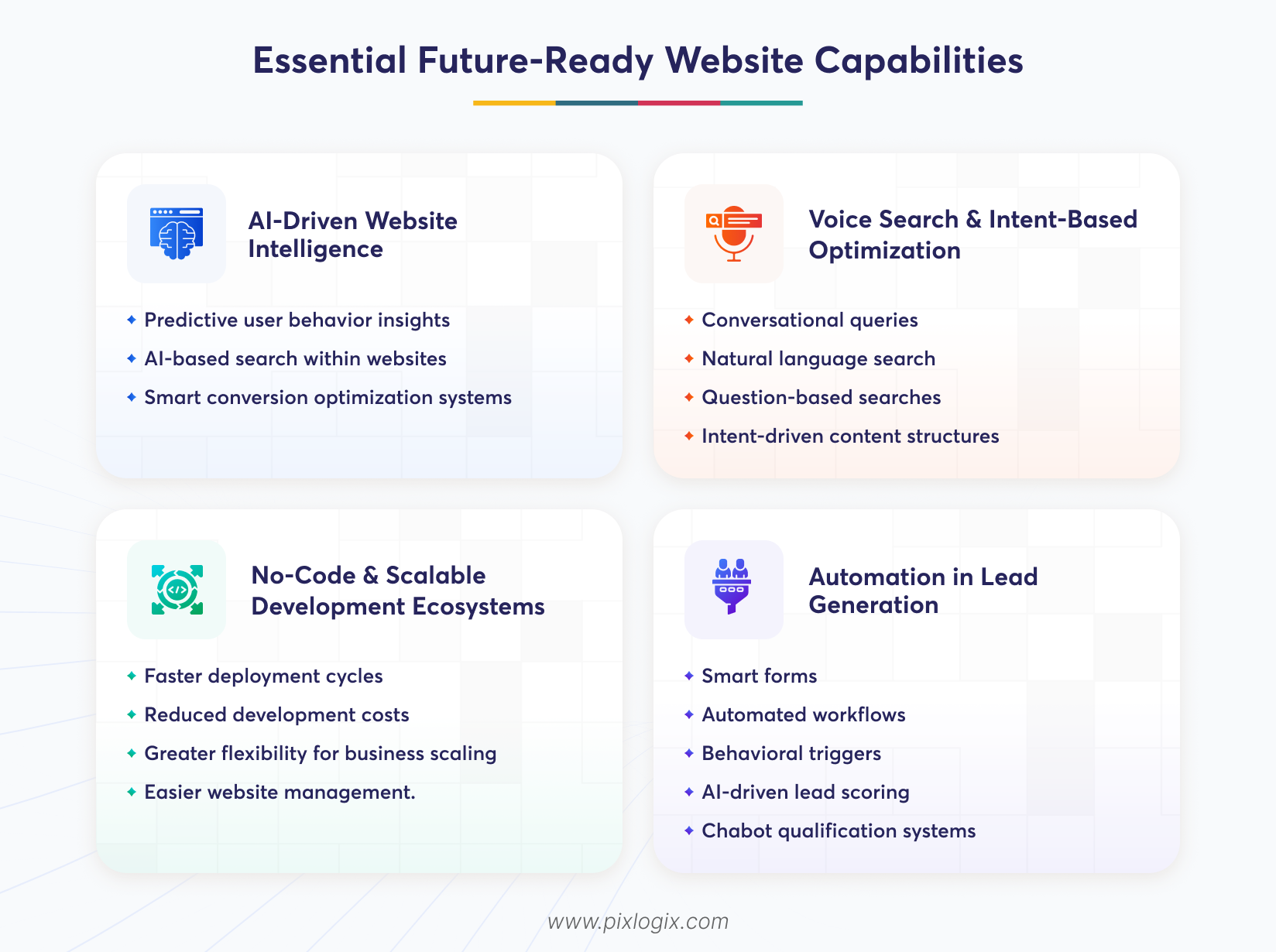
The next wave of website development trends is centered on intelligence, adaptability, and automation. Let’s explore them:
AI-Driven Website Intelligence
In future, business websites will leverage AI to make smarter decisions automatically.
Capabilities include:
- Predictive user behavior insights
- AI-based search within websites
- Smart conversion optimization systems
These features help businesses improve performance continuously. There is no need for constant manual intervention. AI features in business websites can help them respond in real time.
Voice Search & Intent-Based Optimization
Voice search continues to influence user behavior.
This makes it increasingly important to structure content around:
- Conversational queries
- Natural language search
- Question-based searches
- Intent-driven content structures
This improves visibility across traditional search engines and AI-powered assistants. Voice‑first browsing takes it further. It gives companies the chance to claim top positions. It also helps capture users who search in a natural, conversational way.
No-Code & Scalable Development Ecosystems
One of the most practical trends involves scalable frameworks. It helps businesses move faster.
Their benefits include:
- Faster deployment cycles
- Reduced development costs
- Greater flexibility for business scaling
- Easier website management
Businesses increasingly seek platforms that support growth without forcing a full rebuild. This flexibility is quite valuable. It is best for companies that plan to expand services, launch campaigns, or update content frequently.
Automation in Lead Generation
Automation is becoming central to how to design a high-converting business website.
Modern lead generation systems include:
- Smart forms
- Automated workflows
- Behavioral triggers
- AI-driven lead scoring
- Chabot qualification systems
These tools ensure that prospects receive timely engagement. And also it streamlines sales processes. Instead of relying on manual follow-ups, companies can build automated funnel systems. It helps them move leads forward efficiently.
Conclusion
By 2026, the strongest digital properties aren’t just standalone design exercises. They operate as growth systems. Here, experience design, search visibility, and automated workflows work together to perform. They attract, convert, and retain customers.
Modern business website features play a major role here. It’s because businesses now need more than a good-looking interface. They need a site that can guide visitors smoothly. More than that, they want it to respond intelligently. When everything clicks, it shows. Each piece, from design to speed, works together to create momentum that businesses can rely on day after day.
Ready to build a website that converts faster? Then, partner with a leading web development company in India like Pixlogix. We offer a wide range of services. That ranges from website audit to conversion-focused redesign. Our experts make use of the must-have website design 2026 features to create a site that truly connects with their audience’s expectations. Contact us today! Let’s help you move forward digitally with confidence.

Frequently Asked Questions
Which website features are most important for mobile-first users?
Small screens, big expectations. Mobile-first users expect that their site adjusts instantly to any screen size and loads quickly without delays. While using, they want seamless navigation with just a thumb. A short and clear content block is one of the business website essentials. Smooth, simple forms seal the deal, making the whole experience effortless on smaller devices.
What role does AI-ready content structure play in 2026?
Structuring content using AI is quite essential. It helps search engines and voice assistants understand your pages without confusion. Headings guide the reader and the crawler. Schema markup adds meaning behind the words. A logical hierarchy keeps everything connected. When content is clear and concise, it leads to conversational search results.
How important is website speed for lead generation?
Speed wins. A slow site frustrates visitors and pushes them away before they even consider converting. So, then what will a fast website do? They build trust instantly. It also boosts search rankings and guides them to complete a form or booking.
What trust signals matter most to first-time visitors on a business website?
Trust is everything. SSL security shows the site is safe. Reviews and case studies showcase good experiences. Certifications add authority. Clear contact details and privacy policies ensure transparency. Finally, a polished design ties them all. And it will leave a lasting impression.

Written by Samir Bhimbha Founder & CEO
Samir Bhimbha is the Founder & CEO of Pixlogix Infotech Pvt. Ltd. which offers web and app solutions to fulfill business's online needs and help to improve their online presence with many clients in the USA, Europe, Australia, and more. He is a skilled entrepreneur, web designer, developer, and team leader who can handle every situation. With 15+ years of experience in UX/UI design and web development, he is leading a team of IT professional talents.
Related Post
Top 10 Signs Your Website Needs Better UI/UX
Headless Commerce vs Traditional E-commerce

Get in Touch Now!
Have a word with our expert consultants about your next project to get suggestive guidance & proposal.
Sales Inquiry


HR Inquiry
 India’s First SOTD Winner on Awwwards.com – 2010