

What if your Shopify store could load faster and scale effortlessly across every touchpoint? Customer expectations are on the rise today. That’s where businesses need more than a standard e-commerce setup to stay competitive. The Shopify 2026 Commerce Trends report revealed a study about this. According to that, nearly 73% want personalized digital experiences that are faster and smarter. This growing demand is met by headless Shopify development.
So, what is that? The headless approach separates the customer-facing storefront from Shopify’s back-end engine. Thus, the setup becomes simple. It allows businesses to use a front-end while Shopify manages everything.
Now you might think–Why does this matter? A headless e-commerce Shopify approach gives brands greater flexibility and scalability. It also plays a key role in faster website performance. These advantages make it popular.
Are you curious about headless Shopify? This headless Shopify guide walks you through how the architecture works, the benefits it brings, and why businesses are choosing it today. We’ll also detail the development cost and the common mistakes you should consider. And by the end, you’ll know exactly how to build a headless Shopify store confidently.
What is Headless Shopify?
Shopify headless commerce acts as a decoupler. It separates the front‑end presentation layer from the back‑end functionality. So, there is no need to rely on the default theme system. Instead, businesses can build a custom Shopify storefront that connects with users seamlessly.
This setup is known as a headless Shopify architecture. It gives developers the complete design freedom to personalize their journey. But APIs keep both layers connected. It empowers brands to deliver content everywhere, without storefront limits.
Shopify remains the commerce engine behind the scenes. Meanwhile, developers can connect the storefront through Shopify API integration. But how does it happen? Shopify offers a wide range of tools that simplify development.
That includes:
Shopify Storefront API
Allows developers to access products, carts, and checkout functionality from a custom storefront.
Shopify GraphQL API
Enables efficient data retrieval by returning only the required information. This reduces unnecessary requests and improves performance.
Shopify Hydrogen Framework
This React-based framework helps teams build fast and dynamic shopping experiences.
Oxygen
It makes deployment and performance optimization easier. The result? Faster builds, giving developers freedom to innovate at scale.
APIs and Integrations
Offers a strong ecosystem of streamlined tools. They make connected systems smoother, reducing development complexity.
Why Are Businesses Moving Toward Headless Shopify?
A simple store isn’t enough today. That’s where companies are moving toward Shopify headless commerce engines. Here’s how you benefit from them:
1. Performance Needs
Customers expect pages to load quickly, and delays may trigger higher bounce rates. Headless Shopify performance optimization is crucial here. It lets businesses create lightweight storefronts using modern frameworks.
Key performance benefits include:
- Faster page load speeds.
- Improved Core Web Vitals.
- Better mobile performance.
- Enhanced SEO rankings.
- Higher conversion rates.
- Reduced bounce rates.
2. Custom UX Demand
Users also want personalized experiences and engaging interactions that reflect a brand’s identity. With traditional themes, it’s not possible. However, a custom Shopify storefront lets teams control the overall user experience (UX). Thus, developers can work without theme limitations.
Here’s what custom UX include:
- Personalized product recommendations.
- Unique storefront designs.
- Interactive content and storytelling.
- Customized checkout experiences.
- Greater design flexibility.
3. Scalability
Today’s e-commerce infrastructure must support increasing traffic and larger product catalogues. It should grow with expanding operational requirements. Scalable Shopify store development provides this much flexibility.
Their advantages include:
- Support for growing traffic volumes.
- Easier expansion of product catalogues.
- Flexible technology choices.
- Improved stability during high-demand periods.
- Faster implementation of new features.
- Better long-term infrastructure planning.
4. Multi-Channel Selling
Shoppers switch fast. They browse on phones, jump to sites, and expect smooth journeys everywhere. Modern Shopify development meets these goals. With decoupled architecture, it delivers flexibility, speed, and reach across every channel.
Some of them include:
- Websites.
- Mobile applications.
- Progressive Web Apps (PWAs).
- Social commerce platforms.
- Digital kiosks.
- Smart devices and future digital touchpoints.
Key Benefits of Headless Shopify Development
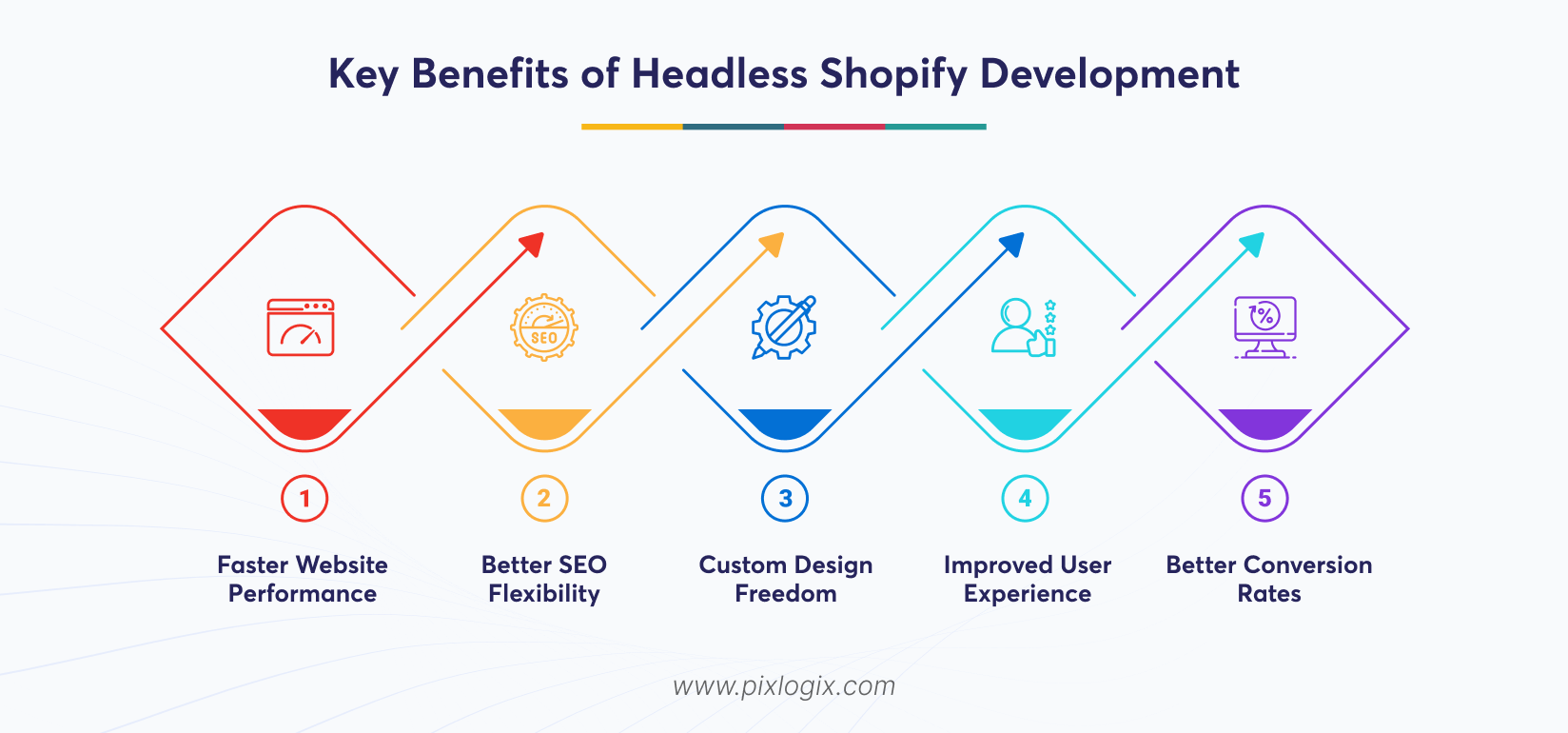
Want to know–why companies need them? Headless architecture offers several benefits, including faster and tailored websites. Take a look in detail:
Faster Website Performance
Shopify storefront API supports modern frameworks like React. This reduces page load times. Faster performance means handling traffic spikes during seasonal sales and product launches is quite easy.
Better SEO Flexibility
Headless architecture gives developers greater control over technical SEO elements, from metadata to schema markup. Thus, businesses can optimize their content delivery. By improving Core Web Vitals, this flexibility can contribute to stronger organic visibility and better discoverability across competitive markets.
Custom Design Freedom
Headless Shopify lets brands escape rigid themes, shaping unique journeys with ease. Teams gain flexibility. As a result, your design sparks emotion and lasting loyalty.
Improved User Experience
A headless framework enables seamless interactions. Thus, brands can deliver personalized content. Moreover, it helps them create more intuitive experiences, which makes finding products easier.
Better Conversion Rates
A well-optimized headless storefront reduces friction and bounce rates. The result? You’ll get faster-loading pages and smoother checkout experiences that retain users in the long run.
Many businesses partner with service providers. They’ll be offering high-grade Shopify store development services to maximize these benefits.
Headless Shopify vs Traditional Shopify
Both have the same commerce engine. But they are designed in a way to serve different business needs. Thinking–what to choose? Explore the comparison below between headless Shopify vs traditional Shopify:
| Feature | Headless Shopify | Traditional Shopify |
| Architecture | Works with a decoupled approach, which separates the frontend and backend framework.
Let developers create custom storefronts and scale them independently. |
Traditional Shopify follows a monolithic model. Here, the storefront, data, and rendering logic exist within the same system.
Shopify uses Liquid templates to generate pages, making setup straightforward and reducing the need for complex integrations. |
| Performance | Headless Shopify creates additional opportunities for performance optimization.
Development teams can implement static rendering, edge computing, and advanced caching strategies. This improves page speed and responsiveness. |
Traditional Shopify already provides reliable performance. This includes built-in caching, CDN delivery, and automatic optimization features.
But limited integrations and plugins might hinder their performance. |
| Flexibility | Headless Shopify removes restrictions. Businesses can build the frontend using modern frameworks and follow any design system without relying on a native rendering model. | Allows merchants to customize their stores. But businesses often encounter limitations when implementing advanced functionality. |
| Maintenance | Requires a hands-on approach. Businesses must maintain frontend frameworks, which increases operational responsibility. But it also provides greater control over the technology stack. | Offers a managed environment. Here, Shopify handles platform updates, security patches, hosting, and infrastructure maintenance.
Let teams focus more on operations and growth rather than technical management. |
| Cost | Requires a larger initial investment. They demand experienced developers and a more structured engineering process, which increases development costs. | It is generally more affordable. Companies can use Shopify’s built-in tools, which reduces costs. |
In general, both differ more in their unique features. Traditional Shopify suits businesses seeking a simple, low-cost, and easy maintenance solution. In contrast, headless Shopify is best for leading brands. Because it helps them prioritize complete control over the customer experience.
Headless Shopify Development Cost
Planning to make an investment with this framework in 2026? Before doing that, you must also understand the basic headless Shopify development cost. But the price varies. It depends on your project needs, ranging from 3,00,000 to 25,00,000 (in INR).
For example, smaller ideas need only basic functionalities. So, their headless Shopify implementation cost is on the lower end. Meanwhile, enterprises seeking advanced features go with larger budget options.
Several factors influence them:
- Technology stack selection.
- Custom UI/UX design requirements.
- Third-party integrations.
- Multi-store capabilities.
- Data migration costs.
- SEO preservation efforts.
- Long-term maintenance.
Now, you might think–how much does it cost to maintain them? Ongoing expenses typically range from 15,000 to 1,00,000 (in INR) and more per month.
Another important question arises here. Why is it more expensive than traditional Shopify? It’s because they require custom frontend development, specialized expertise, and continuous management. However, for growing brands, a Shopify migration to headless can deliver substantial long-term business value.
Common Mistakes in Headless Shopify Development
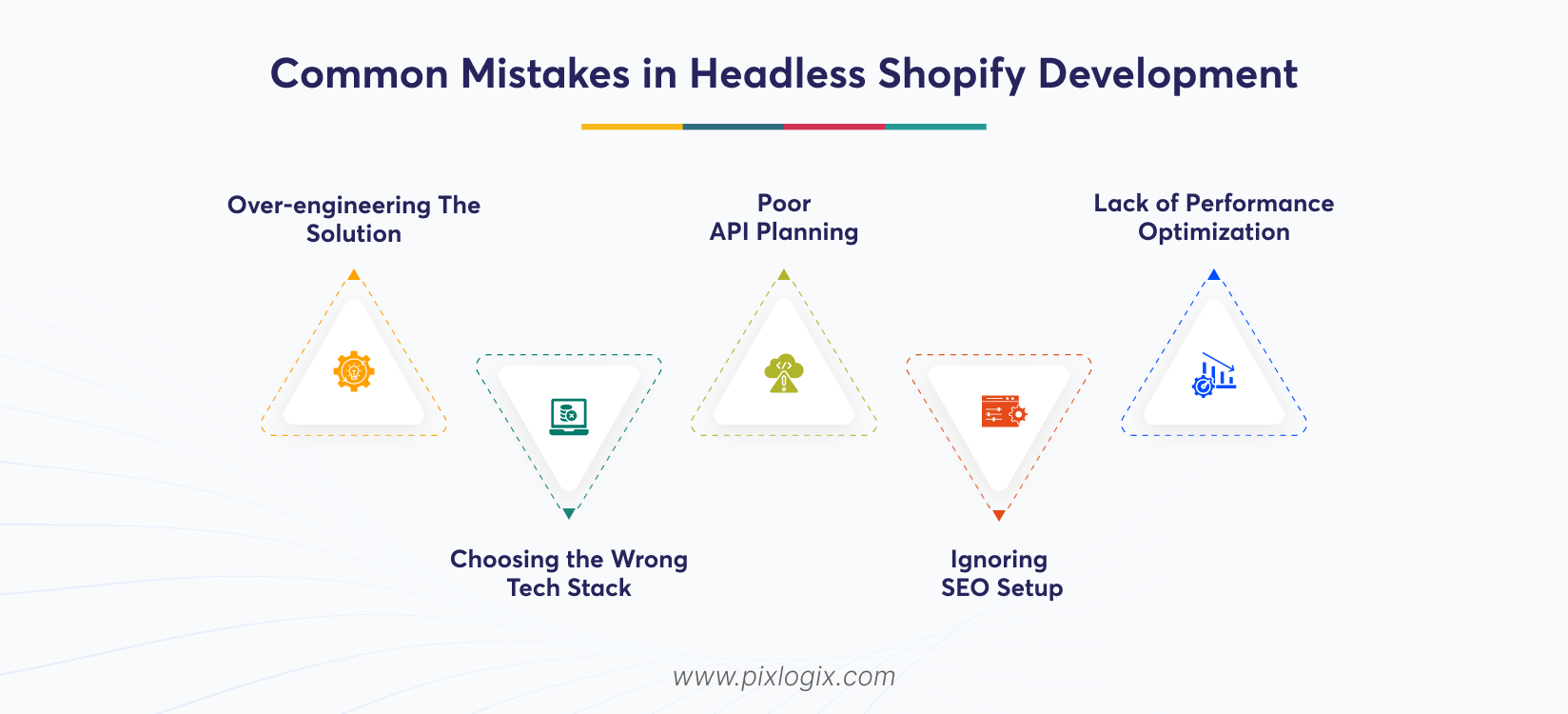
There are so many benefits in headless Shopify implementation. But sometimes businesses make avoidable mistakes. This increases costs and slows down project success. Here’s a look at them with practical solutions:
Over-engineering the solution
Focus more on business goals. Don’t waste your time and money with unwanted features.
Choosing the wrong tech stack
Selecting technologies is a harder part. Because it must align with your team’s expertise and long-term roadmap.
Poor API planning
Design API workflows early to ensure smooth communication between the frontend and Shopify backend.
Ignoring SEO setup
Implement metadata, redirects, and structured data. You can also use the crawlability best practices from the start.
Lack of performance optimization
Maintain fast load times. For this, use caching, image optimization, and efficient code practices.
Follow these practical solutions. It helps unlock stronger performance and scalable growth.
Conclusion
Headless commerce has become a practical solution today. It offers faster performance and the ability to create unique customer experiences. They separate the frontend from Shopify’s backend. However, headless architecture is not the right fit for every store. It differs based on your project needs. But businesses that need complete control over the user experience will benefit the most from headless e-commerce Shopify solutions. On the other hand, the traditional method is preferable for startups and smaller stores with simple requirements.
Ready to build headless e-commerce stores that align with your goals? Then, partner with a top-rated Shopify development company in India like Pixlogix. With custom Shopify website development services, we empower businesses to build future-ready commerce experiences that drive tangible outcomes. Get a quote today! Let’s turn your simple e-commerce idea into a breath-taking brand that everyone remembers.
Frequently Asked Questions
How does Headless Shopify differ from a traditional Shopify theme?
The difference is significant. Traditional Shopify themes rely on Shopify’s built-in Liquid templates. They follow a standard architecture. Headless Shopify, on the other hand, separates the front end from the back end. This gives developers far more flexibility. It also allows them to create fully customized shopping experiences.
What customer-facing features should be tested before launching a headless Shopify store?
Start with the essentials. Test navigation, product pages, the cart, and checkout flows to ensure everything works as expected. Check multilingual content and SEO. Make sure customer accounts, support channels, and analytics tracking function properly. Don’t go live without proper testing. So, confirm that site speed and performance deliver a seamless shopping experience.
Can I go headless with Shopify without hiring a developer?
Yes, but with limits. Headless Shopify requires coding expertise to connect APIs and build custom front ends. So, it’s good to have a developer. If not, you’ll need to depend on low-code tools or prebuilt frameworks.
How much faster is a headless Shopify store compared to a standard theme?
Speed is a major advantage. Headless Shopify stores are often 1.5 to 2× faster than traditional Shopify themes. Page load times can drop to under two seconds. Meanwhile, standard Liquid themes typically load in three to five seconds. This performance boost helps improve Core Web Vitals. It can also lead to higher mobile conversion rates.
What's the ongoing maintenance cost of a headless Shopify site vs a regular one?
Costs are considerably higher. Headless Shopify sites are more expensive to maintain than traditional Shopify themes. Ongoing costs for headless builds can range from $3,000 to $10,000 per month. Meanwhile, standard Shopify plans typically cost between $29 and $299 per month. The added investment comes from custom development, hosting, and ongoing technical support.
Is headless Shopify more expensive than theme-based development?
Headless Shopify is more expensive than theme‑based setups. Traditional themes are affordable and require minimal upkeep. But headless builds demand custom frontend development, external hosting, a separate CMS, and ongoing developer support. As a result, upfront development costs typically range from $10,000 to $30,000, depending on complexity, integrations, and design requirements.

Written by Samir Bhimbha Founder & CEO
Samir Bhimbha is the Founder & CEO of Pixlogix Infotech Pvt. Ltd. which offers web and app solutions to fulfill business's online needs and help to improve their online presence with many clients in the USA, Europe, Australia, and more. He is a skilled entrepreneur, web designer, developer, and team leader who can handle every situation. With 15+ years of experience in UX/UI design and web development, he is leading a team of IT professional talents.
Related Post

Ultimate Guide to Choosing the Right Shopify Theme for Your Brand

How to Create a Custom Shopify Store from Scratch

Get in Touch Now!
Have a word with our expert consultants about your next project to get suggestive guidance & proposal.
Sales Inquiry


HR Inquiry
 India’s First SOTD Winner on Awwwards.com – 2010