

Have you ever walked into any physical store in the US? Then, you might have definitely noticed ramps and accessible restrooms. These aren’t just nice-to-haves. They’re the legal requirements under the Americans with Disabilities Act.
Now the same expectation is moving online. ADA compliance for websites has evolved from a specialized legal concern into a key business imperative. Leading enterprises also fear ignoring them. Because it might expose them to lawsuits and lost customers.
Web accessibility is an afterthought. It was something government agencies and large enterprises worried about, while smaller businesses carried on without concern. That’s no longer the case. Courts have made it clear: a website is a “place of public accommodation.” As daily life moves into browsers and apps, the stakes are higher. Thus, building an ADA-compliant website means enhancing trust. For anyone serious about web design services, accessibility is essential.
In this blog, we’ll break down what ADA website compliance actually means. Let’s also see why it matters more today. By the end, you’ll have an ADA-compliant website checklist in hand. They’ll help you build a high-performing site in the US.
What Is ADA Compliance in Web Design?
So, what is ADA compliance exactly? It means designing digital experiences that even people with disabilities can use. The idea is simple. Anyone in the US with visual impairments, hearing loss, and cognitive conditions can easily access these websites.
ADA itself doesn’t spell out technical specifications for websites. Instead, most businesses turn to the Web Content Accessibility Guidelines. WCAG compliance has become the de facto standard that stands as the reference when evaluating ADA accessibility standards.
Accessible web design benefits far more people. They open doors to screen reader users, people with colour blindness, or an keyboard user due to limited motor control. By 2026, web accessibility isn’t a box to tick. ADA compliant meaning refers to quality web pages that are inclusive and user-friendly.
Why ADA Compliance Is Becoming Essential for US Web Design?
Several forces are pushing ADA regulations for websites into the spotlight this year. Let’s look at them in detail:
Growing Legal Pressure
Accessibility compliance lawsuits are rising. The issues are surprisingly simple-missing form labels, poor colour contrast, or text that screen readers can’t interpret. So, the US government made a huge decision. They stated that legal exposure is no longer reserved for Fortune 500 giants. Every website design company should adhere to these standards. If not, they face the same risks as their larger counterparts.
Better User Experience
Clear navigation makes life easier. From readable typography to logical page structure, all elevate the experience and streamline the way visitors interact with a site. Inclusive ADA web design pushes teams to simplify. And that simplification translates into smoother journeys and fewer frustrations. The result is a more welcoming digital space for all.
SEO, Usability, and Reputation Gains
Search engines love clarity. Well‑structured, fast, and readable websites tend to rank higher. ADA website requirements cover all these SEO needs, from descriptive alt text to semantic HTML. This helps search crawlers understand your content more effectively. On top of that, inclusivity builds trust. This matters more than technical optimization.
Key Features of an ADA-Compliant Website
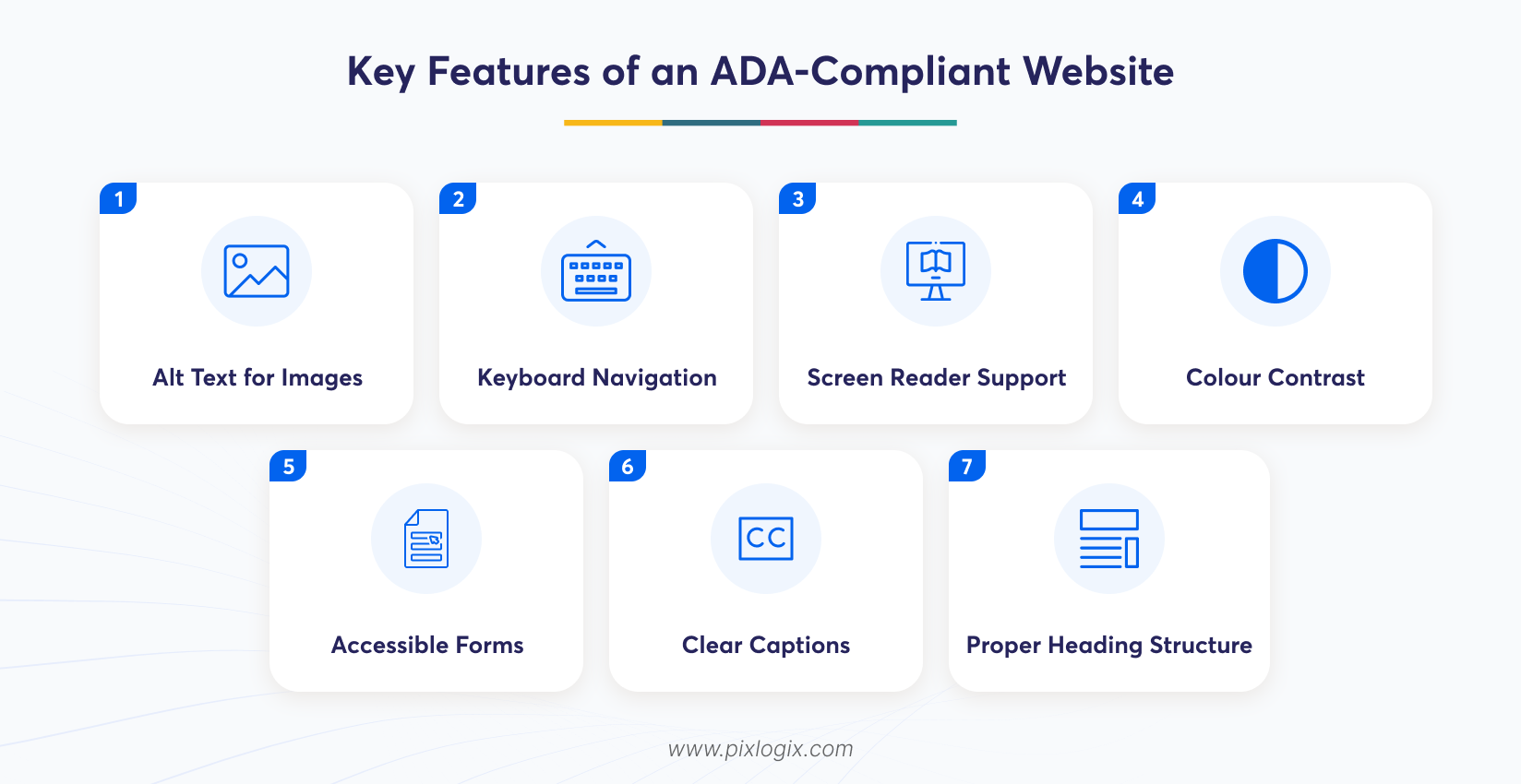
Website accessibility compliance involves addressing several technical and design elements. That includes:
Alt text for images
Every image includes meaningful descriptions. So that screen readers can convey their purpose to visually impaired users.
Keyboard navigation
Users can navigate with keyboard controls alone throughout the site. This includes menus, buttons, and forms.
Screen reader support
Include the right tags. Assistive technologies rely on semantic HTML and ARIA labels. It helps them interpret page structure correctly.
Color contrast
Text and background colors are differentiated with contrast ratios. This makes content legible. Even users with low vision or color blindness can also use the page.
Accessible forms
Input fields have clear labels. Guidance is provided without relying exclusively on color or element positioning.
Clear Captions
Taglines provide clarity. Video and audio content comes with detailed descriptions that explain what’s present there. Thus, users who are deaf or hard of hearing can read them and understand.
Proper heading structure
Headlines are arranged properly based on hierarchy. They help both screen readers and search engines understand content organization.
All these features form the technical backbone of accessible website design. Skipping even one can create a real barrier for real users.
Business Benefits Beyond Legal Compliance
Avoiding lawsuits is one reason. But the business case for digital accessibility runs much deeper. The benefits extend far beyond staying out of court.
Improved user experience
Clear navigation matters. When menus are easy to follow and content is readable, visitors enjoy the experience. They move through your site without friction. The payoff is simple. People stay longer and leave with a better impression of your brand.
Better SEO performance
Search engines notice structure. So, your site should have accessible elements to help crawlers. Then, they can easily interpret and index content. Those website accessibility best practices improve organic visibility.
Wider audience reach
Roughly one in four adults in the US has some disability. This represents a significant customer base that inaccessible sites simply exclude.
Higher engagement
Accessibility drives results. Businesses that invest in inclusive design often see stronger metrics-longer session durations and lower bounce rates. The outcome is clear. ADA compliance turns casual visits into meaningful connections.
Stronger brand trust
Customers often visit websites having inclusive designs. Because it gives them a trusted feel. And that competitive edge sets brands apart in crowded markets.
Common ADA Compliance Mistakes in Web Design
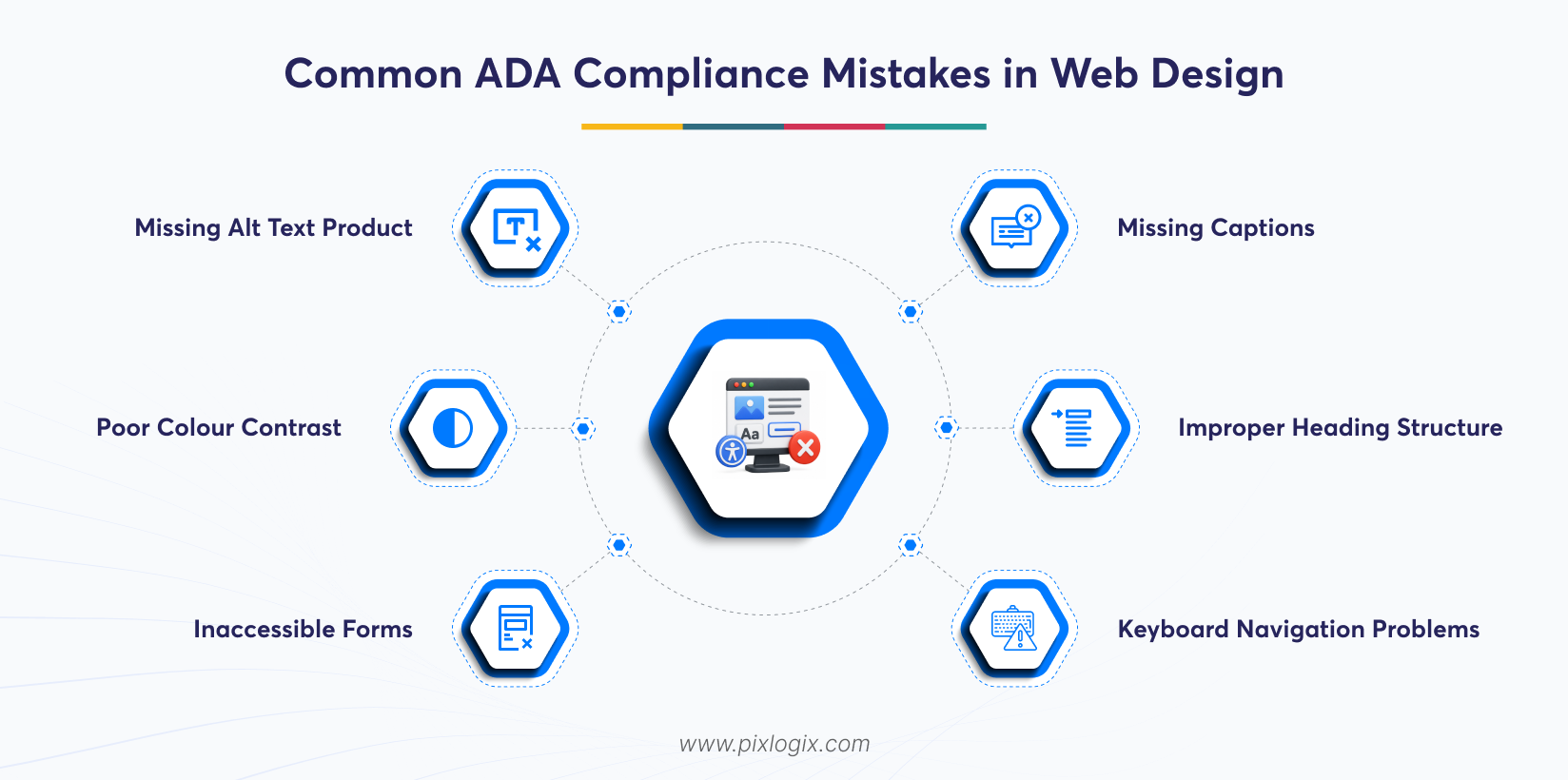
Even well-intentioned teams make recurring errors. That includes:
Missing alt text product
There is no description on images, icons, and banners. This frustrates screen reader users, making them leave.
Poor color contrast
Don’t keep light grey text on white backgrounds. This design trend might look sleek, but it will not meet the website accessibility requirements for US businesses.
Inaccessible forms
Valuable feedback lacks proper labels or relies on placeholder text instead of persistent field labels.
Missing captions
There is no description for video content, which makes it hard to understand.
Improper heading structure
Headings are chosen for visual size rather than logical hierarchy. So, users feel confused and leave before even exploring the whole layout.
Keyboard navigation problems
This includes dropdown menus or modals that trap focus or can’t be closed without a mouse.
These mistakes are common. It’s because they’re easy to overlook during a typical design and development workflow. This is where dedicated accessibility reviews matter.
How to Make Your Website ADA Compliant?
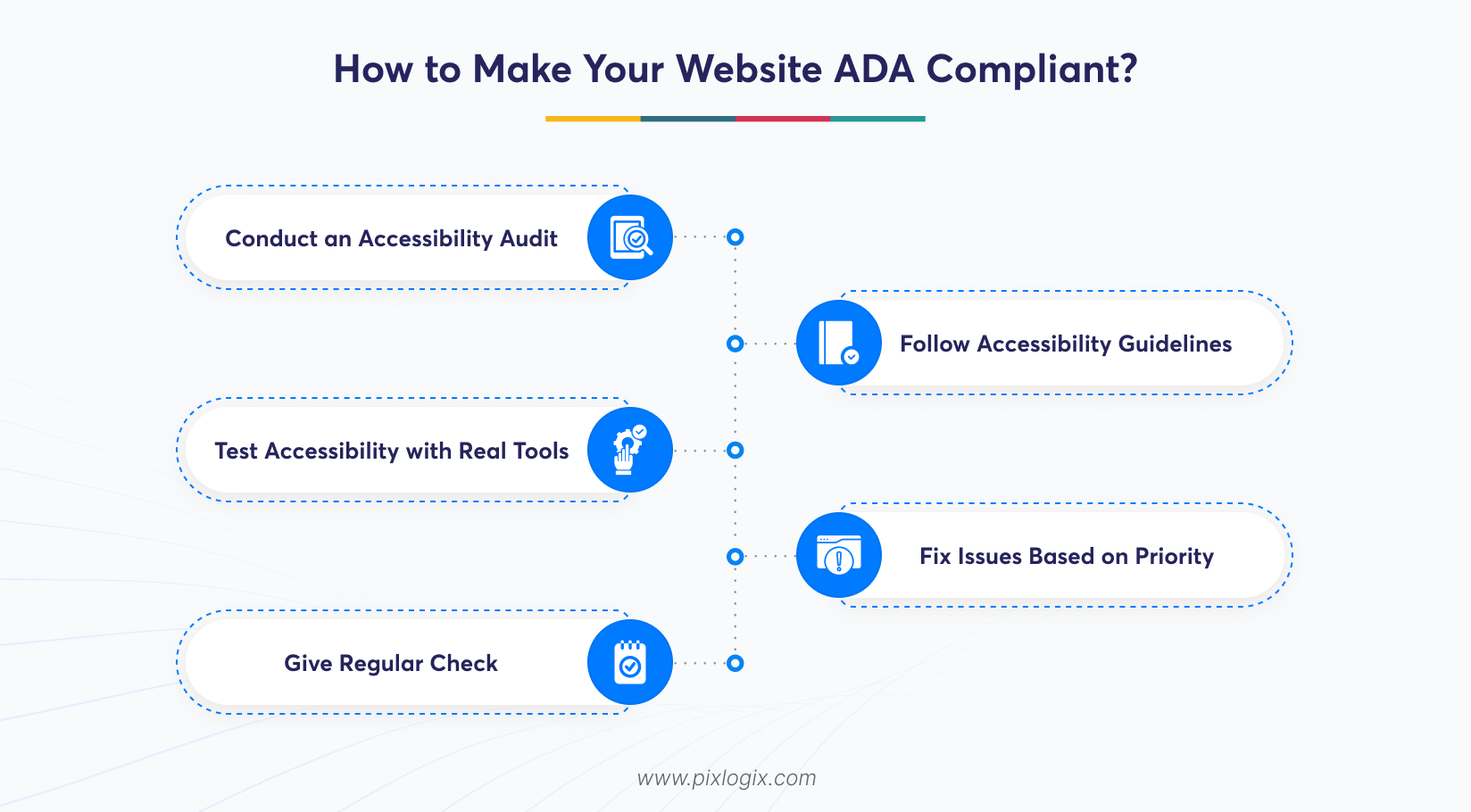
Building an ADA-compliant website isn’t that easy. It requires a structured approach that is quite manageable. Let’s see how:
Conduct an accessibility audit
For checking, use both automated scanning tools and manual testing. The reason is clear. Automated tools are missing roughly 60–70% of real-world issues. Don’t rely on shortcuts. Because manual checks catch the barriers that machines overlook.
Follow accessibility guidelines
Align your site against the AA conformance level. This is the most legal standards reference.
Test accessibility with real tools
Check your website using actual assistive technology. This includes NVDA and keyboard-only navigation. Their reports show the issues that even automated scanners can’t detect.
Fix issues based on priority
Once problems are identified, address them based on severity. Check how frequently users encounter each barrier and resolve the issue accordingly.
Give regular check
Treat accessibility as an ongoing process. Every page should go through periodic audits. This helps maintain compliance as standards continue to evolve.
A professional web design company can simplify this entire process. They bring accessibility expertise into every stage of development, from wireframes to final launch.
Conclusion
ADA compliance is no longer optional. For US businesses, it now shapes every aspect of web design, from legal protection to genuine inclusion. These standards guide the way. Covering WCAG rules, accessible features, common mistakes, and audit-driven fixes builds trust, boosts SEO, and widens reach. It’s not a checkbox. ADA-compliant web design is an ongoing commitment that grows with your site. Act now. So that your website stays compliant, competitive, and welcoming to every American user.
Ready to make your website ADA compliant? Then, partner with a professional web design company in USA like Pixlogix. From designing accessible websites to performing regular compliance reviews, our team handles it all. Get a quote today! We’ll help you build a trusted website that boosts SEO and widens reach.

Frequently Asked Questions
Is ADA compliance legally required for websites in the United States?
No single law spells it out. Even so, businesses cannot ignore their accessibility obligations. Courts across the US have repeatedly ruled that websites count as “places of public accommodation” under the ADA, just like physical stores. The risk is real. If your site isn’t accessible, you can be sued-and many businesses already have been. Most companies now follow WCAG guidelines to stay protected.
Which types of businesses are most at risk if their websites are not ADA compliant?
Honestly, any business with a website can be at risk. But e-commerce stores get hit hardest. It’s because their checkout flows and product pages often have accessibility gaps. Restaurants, healthcare providers, and financial services follow closely. The reason is that people depend on these sites for essentials. Small and mid-sized businesses aren’t safe either, they have accessibility issues.
Can ADA compliance lead to better conversions and sale?
Yes. When your site is easy to navigate, more people can actually complete a purchase. Accessible design often means simpler forms. Cleaner layouts and fewer confusing steps naturally reduce cart abandonment. It’s not just design. Accessible features open the door to a huge group of users, who might have bounced off before. The payoff is clear. Accessibility helps your bottom line as much as it meets legal standards.
How much does ADA website compliance typically cost?
Costs vary. It depends on your site’s size and accessibility issues present. Small audits are lighter. The cost of a basic accessibility review often starts at a few hundred dollars, depending on the professional or agency you choose. Large sites need more. E‑commerce platforms with pages, forms, and interactive features often run into a few thousand dollars. The good news? Once major issues are fixed, staying compliant is far cheaper.
What is the difference between ADA compliance and WCAG compliance?
ADA is the law. It’s a US regulation that says businesses can’t discriminate against people with disabilities, but it doesn’t spell out how to build an accessible website. That’s where WCAG comes in. Created by the W3C, WCAG provides the technical “how”-things like color contrast ratios, keyboard navigation, and proper alt text. Most businesses follow WCAG AA. That’s the level courts reference when deciding if a site meets ADA requirements.

Written by Samir Bhimbha Founder & CEO
Samir Bhimbha is the Founder & CEO of Pixlogix Infotech Pvt. Ltd. which offers web and app solutions to fulfill business's online needs and help to improve their online presence with many clients in the USA, Europe, Australia, and more. He is a skilled entrepreneur, web designer, developer, and team leader who can handle every situation. With 15+ years of experience in UX/UI design and web development, he is leading a team of IT professional talents.
Related Post



Get in Touch Now!
Have a word with our expert consultants about your next project to get suggestive guidance & proposal.
Sales Inquiry


HR Inquiry
 India’s First SOTD Winner on Awwwards.com – 2010