

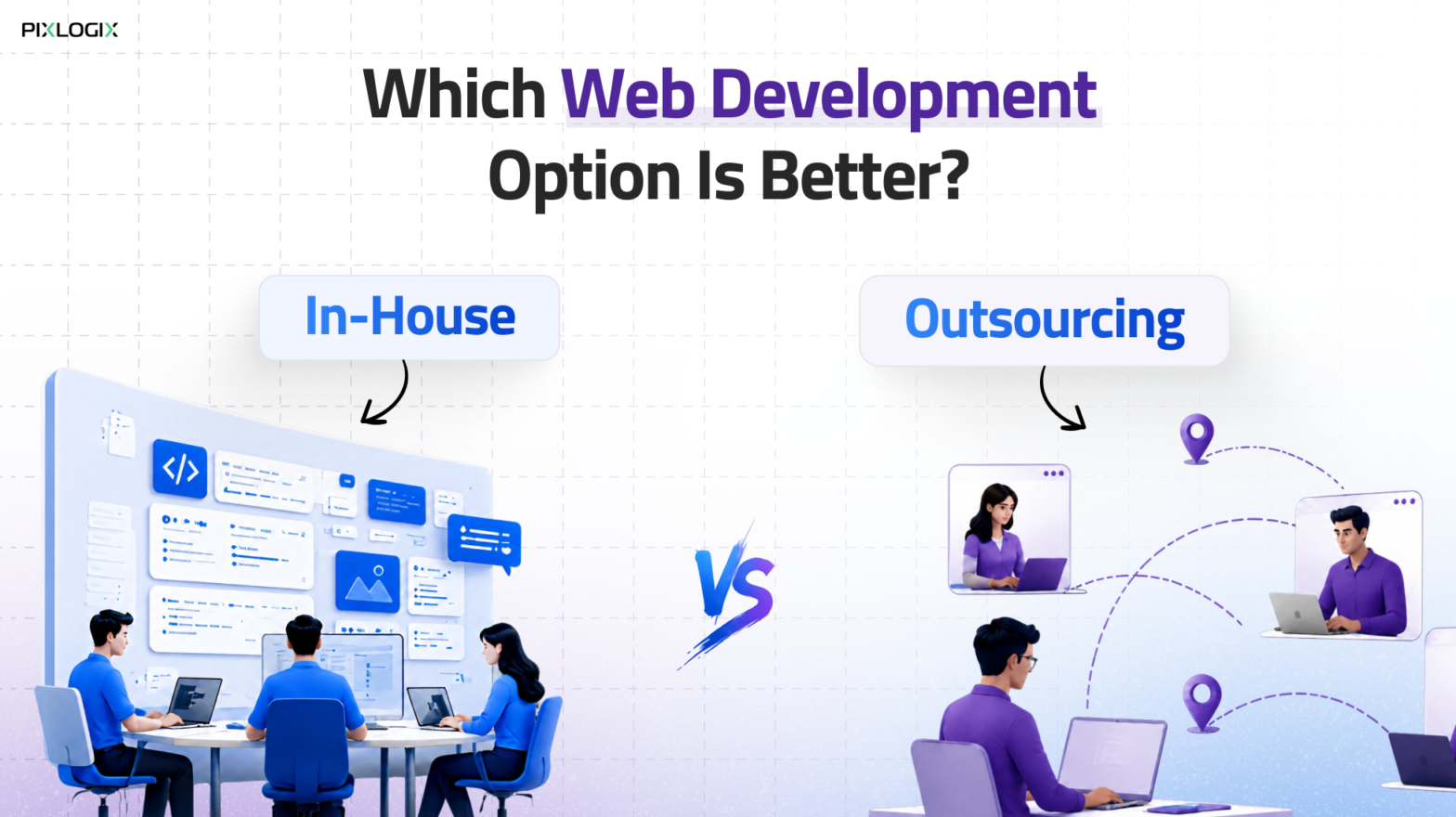
Nine out of ten customers judge a brand by its website. That’s why it’s the backbone of thriving businesses. But there is a huge debate. What’s your choice–in-house vs outsourcing web development? The question has become even more relevant today. It’s because companies are striving to balance budgets, timelines, and technical expertise.
Some value the control and cultural fit of in-house web development. Others lean on outsourcing to cut costs. It also helps them gain access to seasoned professionals with global experience. Now you might think–costs decide the outcome. But it’s not. Project complexity, scalability, security, and long‑term maintenance all weigh heavily on the right model.
A Reuters report revealed shocking numbers in FY2026. According to that data, India’s Global Capability Centres (GCCs) are projected to generate $98.4 billion this year. This is quite strong proof. It highlights that businesses worldwide are increasingly interested in embracing outsourced web development services.
Are you confused–which development option is better? This blog will guide you toward the right decision. From costs and expertise to scalability, we’ll compare both approaches from every angle. This will help you find the right model for your needs.
What Is In-House Web Development?
In‑house web development means companies will build their own team. They’ll not hire an outside vendor. Instead, they’ll recruit developers, designers, quality analysts, and project managers as permanent employees. All of them work only on their projects.
This approach gives businesses complete ownership of the process, from planning and coding, testing, to maintenance. The biggest advantage is ownership. Decisions can be made quickly and changes implemented without waiting on outside schedules. Workflows also remain fully visible.
Thinking–who will choose this? Businesses focused on long-term digital transformation often pick this model. This approach ensures stronger control over product quality. And it maximizes the value of internal resources.
Typical Structure of an In-House Team
When comparing in-house vs outsourcing web development, internal teams consist of several specialists. They all work together throughout the project lifecycle.
Common roles include:
- Front-end developers for user interfaces
- Back-end developers for server-side functionality
- UI/UX designers for customer experience
- QA engineers for testing and quality assurance
- Project managers to coordinate timelines
- DevOps engineers for deployment and infrastructure
Their communication is more direct. Professionals will collaborate daily as everyone works within the same organization. Their business objectives and project priorities are easier to align.
But there is a huge challenge here. Assembling such a team requires significant investment in recruitment and salaries. More than that, software licenses, hardware, and continuous technical training are also needed.
When Businesses Prefer In‑House Development?
Some projects demand complete control. When development stretches across several years, companies often choose to keep everything in‑house.
Companies also prefer internal teams when:
- The website requires constant feature updates
- Business processes are highly customized
- Strong security is needed to protect sensitive data
- Product knowledge must remain within the company
- Long-term innovation is a strategic priority
Their initial investment might be higher. But companies with ongoing development needs often find value in maintaining dedicated internal expertise.
What Is Outsourced Web Development?
Web development outsourcing means hiring an external agency. Their independent development team helps companies design, build, and maintain a website.
Here, they will not recruit full-time employees. Instead, they work with specialists who already have the necessary technical expertise. According to the outsourced web development cost comparison, it depends on specific project needs. Businesses can sometimes outsource an entire website, which is quite costly. In most cases, they search only for specific tasks. This includes UI design, API integration, testing, and maintenance.
Types of Web Development Outsourcing (Onshore, Nearshore, Offshore)
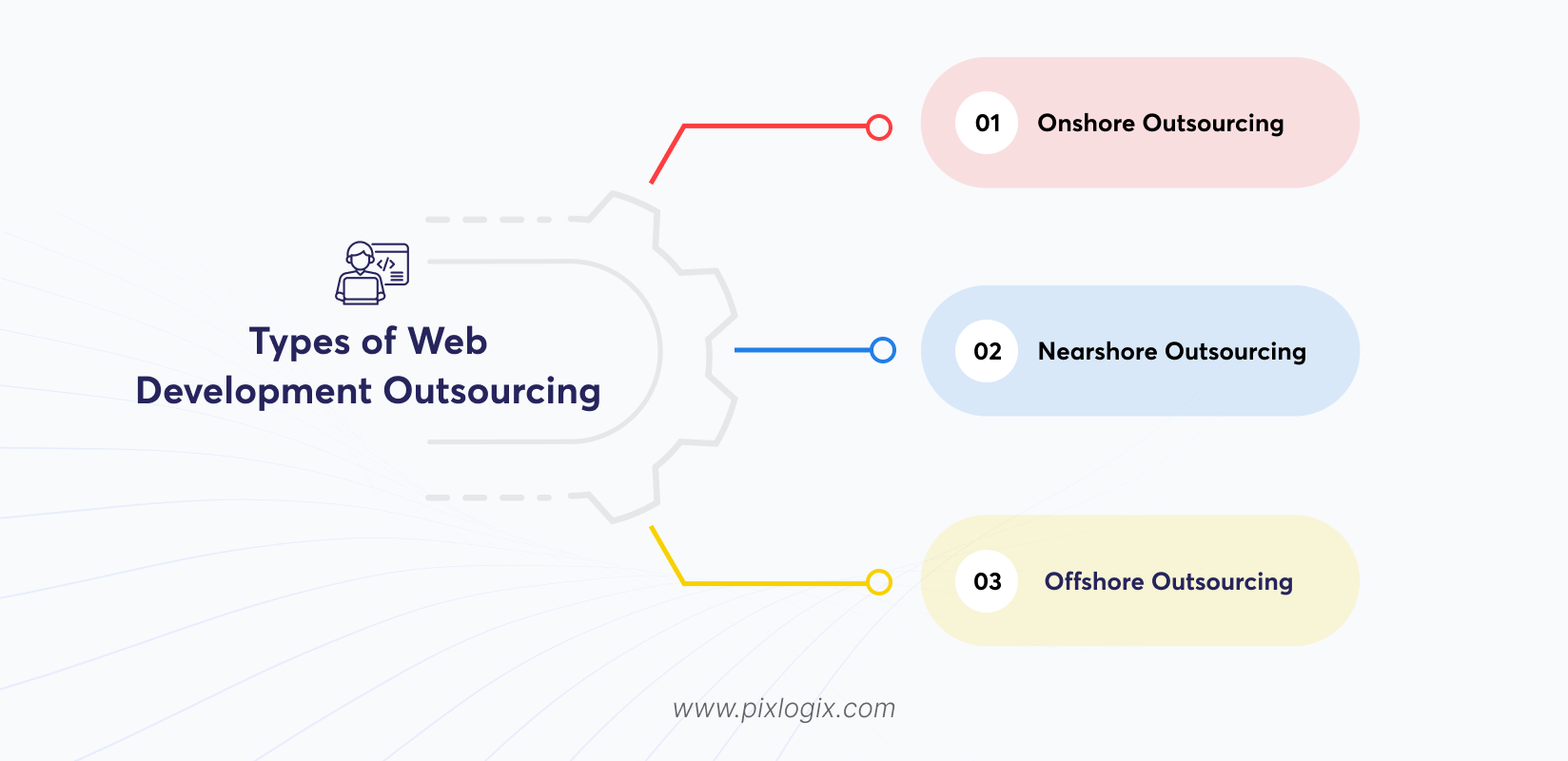
There are three common outsourcing models. They are categorized based on their geographical location.
1. Onshore outsourcing
It involves hiring a development partner within the same country. Thus, communication becomes easy. And legal requirements also look familiar, but project costs are generally higher.
2. Nearshore outsourcing
It refers to teams in neighboring countries or similar time zones. This is a balancing option. It merges affordability and convenient collaboration.
3. Offshore outsourcing
It involves partnering with companies located farther away. They significantly reduce development expenses while providing access to a large global talent pool.
Why Businesses Outsource Web Development?
From cutting expenses to meeting global innovation, the advantages of outsourcing web development are undeniable. This approach doesn’t demand a costly setup.
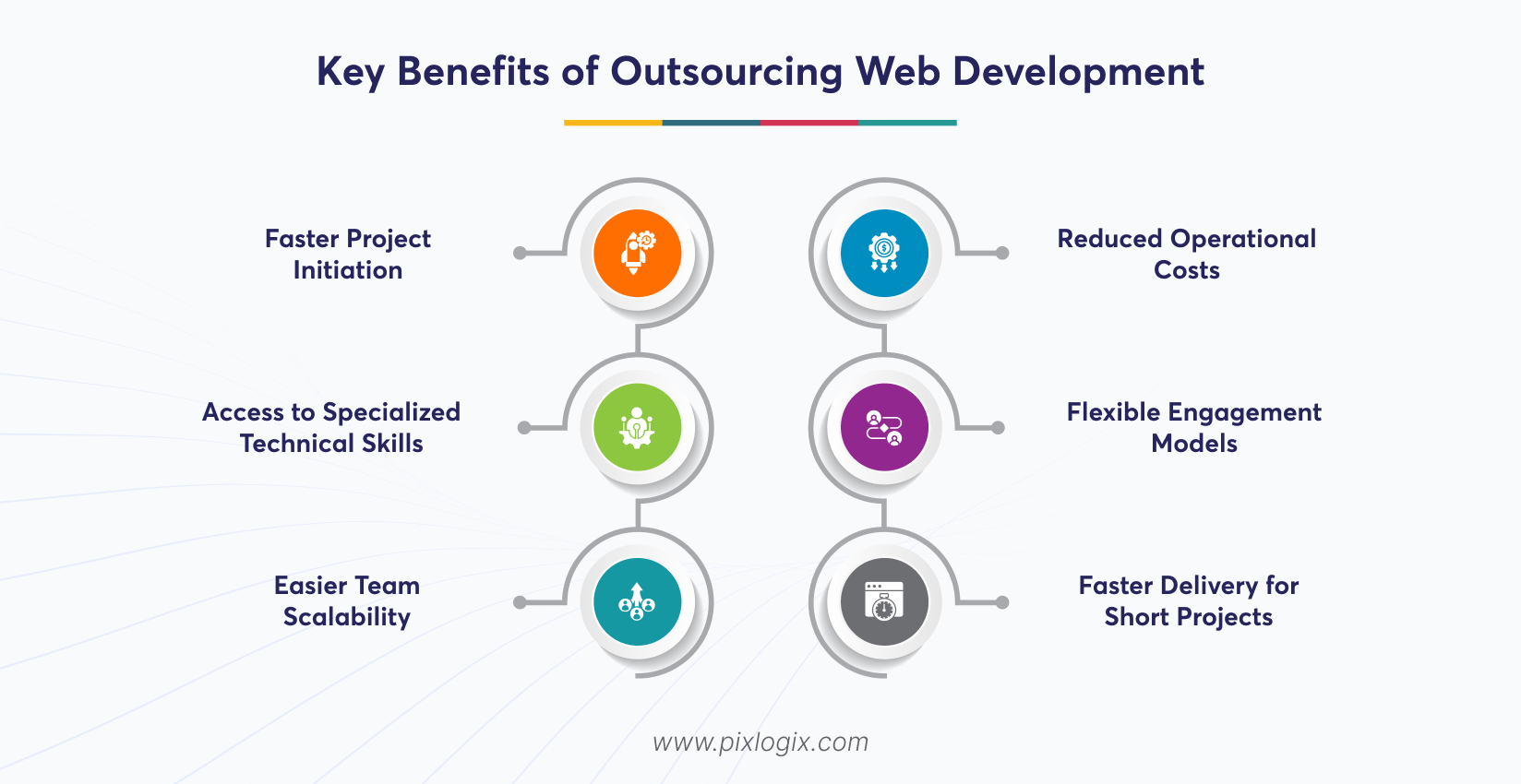
Their huge benefits are:
- Faster project initiation
- Access to specialized technical skills
- Easier team scalability
- Reduced operational costs
- Flexible engagement models
- Faster delivery for short projects
When comparing a web development agency vs. an in-house team, many businesses have outsourced. Because they get help from a specialized expert.
In-House vs Outsourcing Web Development: Key Differences
Making the right choice isn’t always simple. You must understand what each option is, from their budget to timelines. Let’s look at them:
| Factor | In-House Team | Outsourcing |
| Cost Comparison | In‑house development comes with recurring expenses. From salaries and infrastructure to software licenses, all add up over time.
Yet for businesses with ongoing development needs, these costs often translate into stronger long‑term value. |
Follows a project-based or contract-based pricing model. Businesses pay only for the required scope of work, making it more cost-effective for short- and medium-term projects. |
| Talent & Expertise | Internal teams develop deep knowledge. However, expanding expertise often requires additional hiring and training, which can take time. | Provides access to specialists across multiple technologies. This makes them ideal for projects requiring complex technical expertise. |
| Communication & Project Management | Team members work within the same organization. This enables faster communication, quicker approvals, and easier collaboration through direct interaction. | Requires structured communication. This includes project management tools and sprint planning. Their experienced providers maintain transparency through established processes. |
| Flexibility & Scalability | Scaling takes time. It means recruiting new employees and investing in training to bring them up to speed. All these can slow momentum and increase costs. Shrinking a team isn’t easy either. It often involves complex decisions, added risks, and challenges that impact both productivity and morale. | Teams can scale fast. Outsourcing makes it possible to expand or reduce resources quickly. This flexibility is the key advantage. It benefits businesses with changing workloads. |
| Security & Confidentiality | Offers greater control. An in‑house team safeguard sensitive business data and maintains strict compliance standards that align with industry regulations. | Security comes first. Reputable outsourcing partners follow strict compliance standards. But businesses shouldn’t take this for granted. Before engagement, it’s essential to assess a vendor’s security policies. |
Which Development Approach is Better For Different Types of Businesses?
Every organization works on distinct goals. So, before deciding on the option, it’s a must to understand which one your business needs.
Startups
Speed matters to them. Startups often run on very short budgets and fast timelines. So, the internal team never suits them.
Outsourcing helps them access experienced professionals quickly. This method is affordable. And it offers scalable resources that are flexible to grow.
Small Businesses
Balance is their key. Most small businesses need professional websites but don’t want the overhead of a permanent technical department.
That’s where they choose to outsource web development services. It offers affordability and quality. In this approach, a small internal coordinator can help manage ongoing digital operations.
Enterprises
Scale changes everything. Large enterprises manage complex ecosystems like multiple websites and high-end software.
Their governance requirements are quite high. So, many rely on dedicated in-house web development for core systems while outsourcing specialized projects.
Tech Companies
Flexibility is all they want to innovate. Technology companies rarely stick to just one model, because their needs shift with market demands.
They build core platforms internally. Proprietary products and strategic innovations are also handled by in-house web development teams. Meanwhile, technology requirements need outsourcing. They hire external experts for testing, UI, design, and integrations.
How to Choose the Right Web Development Option?
Choosing between a web development agency vs in-house team takes careful thought. Here’s how to decide:
Define Your Budget
Money sets the boundaries. If your budget is limited, then outsourcing is the best choice. They help avoid recurring expenses. This includes salaries, infrastructure, and training.
If you’re planning to invest in the long run, then build an internal team. They may deliver stronger ownership and control.
Evaluate Project Complexity
Some projects may need custom web development services. So, before making a decision, evaluate the complexity level of your project.
Choose outsourcing if you’re going to work with:
- Advanced integrations
- Specialized expertise
- Emerging technologies
These are a strong fit for highly complex requirements.
Choose in-house development if your project demands:
- Continuous innovation
- Deep business knowledge
- Tighter control & scalability
- Faster decision-making
In-house team grows alongside the company’s long‑term vision.
Consider Time-to-Market
Speed can be decisive. Outsourcing usually accelerates delivery because agencies already have expert teams and smart tools.
This is the faster route. So, go with that model if urgency matters more than control. But if long‑term stability is the priority, in‑house development may be worth the wait.
Assess Internal Resources
Look inward first. Do you already have skilled developers or leaders who can handle ongoing maintenance? If yes, expand internally. If not, outsourcing fills the gap without overburdening your existing staff.
Check Long-Term Business Goals
Strategy decides the future. If your vision involves continuous product development, choose in‑house expertise. It ensures ownership and control. For rapid scaling and diverse technical skills, outsourcing aligns better with growth.
Conclusion
Nowadays, there is a big debate among business owners. They are struggling to choose between in‑house vs outsourcing web development. Both models bring advantages. In the same way, both also carry challenges that can hinder their growth. So, the choice is yours. Decide based on your long‑term business strategy.
An internal team offers greater ownership. It also offers deeper business knowledge and stronger control over processes. The outsourcing option is very flexible. With specialized expertise, they ensure faster delivery and lower upfront cost. But here’s the catch. Many successful organizations even combine both approaches to maximize efficiency.
Your today’s decisions will not only shape your project’s success. But it also influences your company’s future trajectory.
Need expert guidance to choose the right web development approach? Then, make Pixlogix your web development partner. Our experts evaluate your requirements and build a personalized solution. Contact us today! We explain what each one offers and help you find the suitable model.

Frequently Asked Questions
What is the total cost of hiring an in-house web developer vs outsourcing a project?
Hiring in‑house isn’t cheap. The total cost includes salaries, recruitment, employee benefits, office infrastructure, software licenses, training, and long‑term employment expenses that continue year after year. Outsourcing, by contrast, is simpler. It usually involves a fixed project fee or contract‑based pricing, making it more affordable.
What hidden costs should businesses consider when hiring in-house developers?
Costs go beyond salaries. Businesses also need to account for hiring expenses, onboarding, employee benefits, and hardware. Software subscriptions and workspace overheads also add up here. Training and retention bring another layer.
Which option is more cost-effective for small and mid-sized businesses?
Small and mid-sized company owners often pick the outsourcing method. Because it gives them access to experienced professionals. That means lower costs and faster execution. But the story doesn’t end there. Companies with continuous development requirements prefer a hybrid approach to deliver the best results.
What tasks are best outsourced, even when you already have an internal team?
Organizations often outsource UI/UX design. Security audits, API integrations, and QA are commonly handled externally. Cloud migration is another outsourced task. SEO and specialized technology implementations require niche expertise. All these were the best outsourced tasks for tangible outcomes.
How long does it typically take to build a business website when outsourcing vs in-house?
Timelines depend on complexity. A standard business website can often be completed by an experienced outsourcing agency within 6–12 weeks. In‑house projects, however, may take longer. Recruitment, onboarding, or limited internal resources can slow progress, especially for companies building a team from scratch.

Written by Samir Bhimbha Founder & CEO
Samir Bhimbha is the Founder & CEO of Pixlogix Infotech Pvt. Ltd. which offers web and app solutions to fulfill business's online needs and help to improve their online presence with many clients in the USA, Europe, Australia, and more. He is a skilled entrepreneur, web designer, developer, and team leader who can handle every situation. With 15+ years of experience in UX/UI design and web development, he is leading a team of IT professional talents.
Related Post

Get in Touch Now!
Have a word with our expert consultants about your next project to get suggestive guidance & proposal.
Sales Inquiry


HR Inquiry
 India’s First SOTD Winner on Awwwards.com – 2010